President Bush released the new National Security Strategy of the United States today, and while there doesn't seem to be anything really new or innovate in it, it's still worth discussing. Two things are most noteworthy: That the document seems to identify Iran as the greatest threat facing the US, and that the commitment to pre-emptive strikes (the "Bush Doctrine") is re-affirmed. There is also a strong commitment to democratic norms and ideals...the report singles out North Korea, Iran, Syria, Cuba, Belarus, Burma and Zimbabwe as seven despotic states (p. 3), although there isn't much mention of what to do about them.
I've already blogged a lot about Iran here, so I won't really discuss that anymore. Suffice it to say that I agree that Iran is the #1 threat to the US....
The discussion of pre-emptive war is very interesting however. On p. 23, the Strategy states that "under long-standing principles of self-defense, we do not rule out the use of force before attacks occur, even if uncertainty remains as to the time and place of an enemy's attack. When the consequences of an attack with WMD are potentially so devastating, we cannot afford to stand idly by as grave dangers materialize. This is the principle and logic of pre-emption."
Actually, what is being described here is the logic of preventive war, not pre-emption. As normally understood, the difference between the two is one of time horizons: A pre-emptive strike is launched in response to a clear and imminent threat from an enemy; a preventive war is launched to prevent an enemy from becoming stronger in the future, thereby fighting the war on terms favorable to preventor, not the preventee. Israel's attack on Egypt and Syria in 1967 is the classic example of pre-emption; the enemies forces were mobilizing, and by all accounts, an attack was pending in the immediate future. Attacking, for example, China today rather than risking a war in the future when China would be stronger would be an example of preventive war. Israel's strike against Iraq's Osiraq nuclear reactor also qualifies as a preventive strike, as the threat being nullified was years, not days, away.
What Bush is doing here is conflating the two as was done in the run-up to the invasion of Iraq in 2003. The argument is that when the threat is terrorists armed with WMDs, there will not be the types of warnings and signals that typically foreshadow conventional wars. Terrorists do not call up reserves, they do not mass troops at the borders or scramble air assets, their movements cannot be tracked with satellites. These facts, combined with the potential damage of a WMD, make traditional pre-emption obsolete. As Bush said in a speech of October 8, 2oo2, "Facing clear evidence of peril, we cannot wait for the final proof -- the smoking gun -- that could come in the form of a mushroom cloud." Thus, the time horizon for pre-emption must be moved back; it is no longer a clear and imminent threat, but rather the possibility of a threat, that may trigger a first strike by the US.
This conflation is troubling for several reasons. First, while pre-emption is considered both legal and legitimate, preventive war is neither. Now, regular readers will know that I do not concern myself to greatly with the dicates of international law, but legitimacy is a different story, and (un)fortunately the two often coincide. The US is the global hegemon, true, but it tries to be benevolent one. It does not force other states to join its institutions or follow its rules, but tries to convince others that it is in their benefit to do so. That task is made easier if US leadership is viewed as legitimate. Launching wars seen by most observers as preventive, as was Iraq, compromises US legitimacy and undermines American leadership and hegemony. Now, the US need and must not always defer to international consensus; quite the contrary. But unilateral action must be reserved for only the most dire of situations, when the security of the nation is truly threatened in a nearly existential sense.
Second, as the Iraq War more than demonstrated, intelligence is a tricky beast. The difficulty in knowing intentions as well as knowing capabilities is one of the main reasons that preventive war is not accepted in the international community. Combined with the previous point makes for all the more reason to be exceedingly careful and cautious before launching preventive wars.
Third, the kinds of threats President Bush is envisioning are not easily taken out with limited strikes; rather the problem tends to come from corrupt, dicatorial, and despotic regimes. It would be one thing if Bush was talking about strikes like that by Israel against Osiraq; a limited strike designed to eliminate a specific threat, like Iran or North Korea's nuclear program. But when the threat is despotic regimes in cahoots with terrorists, preventive war takes on a different cast, as it did in Iraq. It's one thing to use Special Forces or air platforms to take out a nuclear reactor, uranium enrichment plant, or even a military asset. It's another thing entirely to take over an entire country. But this is where the logic of the National Security Strategy leads.
Now, I am not in principle opposed to any of the logical or strategic arguments being made in the Strategy. I am just wary of where they lead. The US must be proactive and try to deter states from proliferating WMD and sponsoring/cooperating with terrorists. Invading Afghanistan and Iraq were powerful signals of deterrence. But the US must also be careful about how it uses it power. Iraq must be used, to some degree, as a cautionary tale; preventive war can sometimes be more trouble than it's worth.
Thursday, March 16, 2006


Wednesday, March 15, 2006
More on Taiwan
Michael Turton's comment to my post about China and Taiwan deserves a direct response. First, Mr. Turton grossly mischaracterizes the Anti-Secession Law passed by China in early 2005. Yes, the law does raise the possibility of using force to retake Taiwan, but only if Taiwan continues to move towards independence. Here is the relevant section from the Anti-Secession Law:
The "deal" Mr. Turton claims does not exist is the quid pro quo known as "strategic ambiguity" by which the US has controlled and smoothed problems between China and Taiwan: Taiwan will not seek or move towards de jure independence and China will not seek to forcefully reunite with Taiwan. This deal is an absolutely critical part of US-China relations, and without it, the US would not be willing to support Taiwan. China is simply too important to the US, both economically and strategically, to allow the Taiwan question to scuttle US-Sino relations. It will never be allowed to happen. If the US is forced to choose between protecting Taiwan and good relations with China, Taipei has no chance. Only this non-existent deal has kept Taiwan safe and indepdent in a de facto sense.
Mr. Turton castigates the Chinese for crying to the US to restrain Taiwan in this instance, writing that "It's a might hypocritical for China to yammer for three decades that the US is interfering, and then suddenly ask the US to interfere." This is not hypocritical at all. China has accepted the concept of "strategic ambiguity" and has allowed the US to shore up Taiwan, so long as there are no moves towards independence. Abolishing the Council, even if only symbolic, represents such a move.
Make no mistake. China will use force to prevent Taiwan from obtaining formal sovereign indepdence. It may be true that China does not have a sufficient amphibious force projection capability to invade, but China does have a large long-range strike force, in missiles and airplanes.
Mr. Turton further complains that "There isn't any balance anymore. China now has military ascendancy over Taiwan, and the US has been tilting toward China for the last twenty years. The "ambiguity" that you refer to in your second paragraph has been replaced by a veiled agreement that China can annex Taiwan, an island no ethnic Chinese emperor ever owned. The US simply says it cannot do so by force. At the moment, the US position, weirdly, is that it is willing to go war to prevent violent annexation." All of this is true, except for the implication that this is anything new. China has always enjoyed military dominance over Taiwan, and the US has long supported the policy of "strategic ambiguity" to manage Sino-Taiwanese relations.
Taiwanese independence is a fact that China cannot undo by diplomacy, unless Taiwan consents. The longer Taiwan exists, the harder that fact becomes. And as the Chinese leaderhip ages and moderates itself, the more chance there is that, somewhere in the future, China will allow, to some degree, Taiwanese legal sovereignty. By rocking the boat now, Taiwan is compromising any chances it may have in the future.
Turton concludes by claiming that "It is both curious and sad that you regard Taiwan, the victim in this case, and the last legacy of the Great Game of the 19th century, as the cause of the problem. Independence and democracy are not threats to anyone. Rather, people who make threats and point missiles are the problem." True. Politics is a nasty business. I would wager that all US presidents would prefer to support a democratic Taiwan instead of a communist China. But political reality dicates the opposite behavior.
Finally, if Taiwan so desperately wants independence and formal de jure sovereignty, there is nothing that US or China can do to stop Taiwan from declaring a split with China. So why doesn't Taiwan make such a move? Because it can't survive without US support. If Taiwan can't maintain its independence without the US, then Taiwan needs to do what the US asks of it. America will not, and should not, come to Taiwan's aid if it provokes a Chinese attack.
Article 8 In the event that the "Taiwan independence" secessionist forces should act under any name or by any means to cause the fact of Taiwan's secession from China, or that major incidents entailing Taiwan's secession from China should occur, or that possibilities for a peaceful reunification should be completely exhausted, the state shall employ non-peaceful means and other necessary measures to protect China's sovereignty and territorial integrity.This is simply a codification of the existing status quo, which Taiwan has been doing more to undermine than has China.
The State Council and the Central Military Commission shall decide on and execute the non-peaceful means and other necessary measures as provided for in the preceding paragraph and shall promptly report to the Standing Committee of the National People's Congress.
The "deal" Mr. Turton claims does not exist is the quid pro quo known as "strategic ambiguity" by which the US has controlled and smoothed problems between China and Taiwan: Taiwan will not seek or move towards de jure independence and China will not seek to forcefully reunite with Taiwan. This deal is an absolutely critical part of US-China relations, and without it, the US would not be willing to support Taiwan. China is simply too important to the US, both economically and strategically, to allow the Taiwan question to scuttle US-Sino relations. It will never be allowed to happen. If the US is forced to choose between protecting Taiwan and good relations with China, Taipei has no chance. Only this non-existent deal has kept Taiwan safe and indepdent in a de facto sense.
Mr. Turton castigates the Chinese for crying to the US to restrain Taiwan in this instance, writing that "It's a might hypocritical for China to yammer for three decades that the US is interfering, and then suddenly ask the US to interfere." This is not hypocritical at all. China has accepted the concept of "strategic ambiguity" and has allowed the US to shore up Taiwan, so long as there are no moves towards independence. Abolishing the Council, even if only symbolic, represents such a move.
Make no mistake. China will use force to prevent Taiwan from obtaining formal sovereign indepdence. It may be true that China does not have a sufficient amphibious force projection capability to invade, but China does have a large long-range strike force, in missiles and airplanes.
Mr. Turton further complains that "There isn't any balance anymore. China now has military ascendancy over Taiwan, and the US has been tilting toward China for the last twenty years. The "ambiguity" that you refer to in your second paragraph has been replaced by a veiled agreement that China can annex Taiwan, an island no ethnic Chinese emperor ever owned. The US simply says it cannot do so by force. At the moment, the US position, weirdly, is that it is willing to go war to prevent violent annexation." All of this is true, except for the implication that this is anything new. China has always enjoyed military dominance over Taiwan, and the US has long supported the policy of "strategic ambiguity" to manage Sino-Taiwanese relations.
Taiwanese independence is a fact that China cannot undo by diplomacy, unless Taiwan consents. The longer Taiwan exists, the harder that fact becomes. And as the Chinese leaderhip ages and moderates itself, the more chance there is that, somewhere in the future, China will allow, to some degree, Taiwanese legal sovereignty. By rocking the boat now, Taiwan is compromising any chances it may have in the future.
Turton concludes by claiming that "It is both curious and sad that you regard Taiwan, the victim in this case, and the last legacy of the Great Game of the 19th century, as the cause of the problem. Independence and democracy are not threats to anyone. Rather, people who make threats and point missiles are the problem." True. Politics is a nasty business. I would wager that all US presidents would prefer to support a democratic Taiwan instead of a communist China. But political reality dicates the opposite behavior.
Finally, if Taiwan so desperately wants independence and formal de jure sovereignty, there is nothing that US or China can do to stop Taiwan from declaring a split with China. So why doesn't Taiwan make such a move? Because it can't survive without US support. If Taiwan can't maintain its independence without the US, then Taiwan needs to do what the US asks of it. America will not, and should not, come to Taiwan's aid if it provokes a Chinese attack.
Monday, March 13, 2006
Dealing With Iran
"We are extremely disappointed with the way Iran is behaving in the course of these talks. Iran is absolutely no help to those who want to find peaceful ways to solve this problem." These are not the words of US Ambassador to the UN John Bolton, US President Bush, or even British PM Tony Blair. Rather, this quote issues from Russian Foreign Minister Sergei Lavrov. In the wake of Iranian rejection of the proposed Russian compromise plan -- which would have allowed Iran to develop a nuclear program using uranium enriched in Russia -- Iran's staunchest ally, Russia, appears to be at the end of its rope.
However, such frustration only goes so far. Russia and China are still opposing UN Security Council action, including sanctions, on the issue. Russia wants the issue to stay under the aegis of the IAEA, which can negotiate but has no power to threaten or punish. In the absence of unanimity of the five veto-holding members, the Security Council is stymied and unable to act, so for now, the IAEA is the only possible option.
Now is the time for the US to capitalize on Russia's frustration with Iran, and begin trying to pry the two states apart from one another. The US needs to develop a package of "carrots" that Russia would accept to move the debate into the Security Council and allow sanctions to be placed on the table. Until the international community gets serious, Iran has no reason to even consider compliance.
Good Riddance
Slobodan Milosevic is dead. My only sadness is caused by the thought that his passing was likely painless, unlikely the countless miseries he inflicted on others.
Some lament that now justice will not be served. While I sympathize with this sentiment, I was skeptical that the ICTY would have been able to return a guilty verdict.
Mugabe...Hussein...Kim-Jong Il...who's next?
Some lament that now justice will not be served. While I sympathize with this sentiment, I was skeptical that the ICTY would have been able to return a guilty verdict.
Mugabe...Hussein...Kim-Jong Il...who's next?
Friday, March 10, 2006
The Evidence Against Saddam Hussein
Over at The Grotian Moment blog (dedicated to examining legal issues surrounding the trial of Hussein) is a truly astounding link. Here, you can see jpeg images of all of the evidence that will be presented against Hussein. True, it's all in Arabic, but it's still amazing. Take a look.
Reforming the UN Human Rights Commission
I had promised myself that I wasn't going to blog about the UN today. I've been savaging international law and the UN lately, and I was ready to give it a rest. Unfortunately, castigating the UN is like shooting fish in a barrel...it's just too easy, and the opportunity always presents itself.
In today's Chicago Tribune, Senate Majority Leader Bill Frist (R-TN) has an excellent op-ed urging the US to withdraw from the UN Human Rights Commission if it doesn't adopt the more serious reforms auggested by the US, including standards to keep gross violators like Sudan and Zimbabwe off of the Commission. Frist notes that "this international human rights monitor can point to few successes. It failed to speak out against communism, failed to act against Rwanda's genocide and failed to condemn nations that sponsor terrorism. Every day, governments from Venezuela to China, and from Saudi Arabia to Eritrea, take actions that belie any commitment to human rights. The commission, however, remains virtually silent."
Among the problems that Frist notes in one that I've been harping about for some time now: the UN's commitment to sovereign equality at the expense of values and ideals. "While any commission needs geographic diversity, human rights records have to come first: Current geographic quotas reserve seats on the commission for 15 African nations even though international democracy monitor Freedom House says the continent has only seven truly free countries." Furthermore, Frist argues "with 53 members, the current commission is too large to conduct business efficiently. We should cut the number of nations seated on an international human rights body by at least a third and require that new members secure overwhelming support."
But most interesting of all, Frist suggests that:
If the US were to leave the UN Human Rights Commission, it would be truly exposed for the worthless, ineffective body that it is. And if the US could entice its ideological ilk to join it in creating a new human rights organization, outside of the UN and without a strict commitment to sovereign equality, that commission could actually have some power in enticing states to improve their behavior.
Any such commission should be linked into a larger network of liberal states, such as NATO, the WTO, the World Bank, and the IMF, that would provide incentives for other states to join. If you want membership in NATO, if you want the free trade benefits of the WTO, if you want to be eligible for loans from the World Bank or the IMF, join the human rights body as well. The presence of carrots and sticks would make it possible for real punishments. Of course, these would apply to the US as well, but the US has already agreed to international oversight of its trading practices, so why not its human rights record?
In today's Chicago Tribune, Senate Majority Leader Bill Frist (R-TN) has an excellent op-ed urging the US to withdraw from the UN Human Rights Commission if it doesn't adopt the more serious reforms auggested by the US, including standards to keep gross violators like Sudan and Zimbabwe off of the Commission. Frist notes that "this international human rights monitor can point to few successes. It failed to speak out against communism, failed to act against Rwanda's genocide and failed to condemn nations that sponsor terrorism. Every day, governments from Venezuela to China, and from Saudi Arabia to Eritrea, take actions that belie any commitment to human rights. The commission, however, remains virtually silent."
Among the problems that Frist notes in one that I've been harping about for some time now: the UN's commitment to sovereign equality at the expense of values and ideals. "While any commission needs geographic diversity, human rights records have to come first: Current geographic quotas reserve seats on the commission for 15 African nations even though international democracy monitor Freedom House says the continent has only seven truly free countries." Furthermore, Frist argues "with 53 members, the current commission is too large to conduct business efficiently. We should cut the number of nations seated on an international human rights body by at least a third and require that new members secure overwhelming support."
But most interesting of all, Frist suggests that:
If the UN doesn't approve a meaningful reform package by the commission's March 13 meeting, the U.S. should seriously consider joining with other responsible countries to create a new human rights body outside of the UN system. We could jump-start such an initiative by withdrawing the U.S. share of funds that would otherwise go to the Human Rights Commission and giving those resources to the new organization.This is an excellent idea. Despite the scorn heaped on the US by much of the international community, the US is a vital cog in the functioning of the UN and the Human Rights Commission in particular. When the US was kicked off of the Commission several years ago as punishment for, in essence, its hegemonic behavior, the Commission became even less competent and capable than it is normally. The US is the only country with the leverage, credibility, and assets to craft compromises, advance negotiations, and acheive any kind of meaningful progress. Tellingly, the US was voted back on to the Commission at the next opportunity.
If the US were to leave the UN Human Rights Commission, it would be truly exposed for the worthless, ineffective body that it is. And if the US could entice its ideological ilk to join it in creating a new human rights organization, outside of the UN and without a strict commitment to sovereign equality, that commission could actually have some power in enticing states to improve their behavior.
Any such commission should be linked into a larger network of liberal states, such as NATO, the WTO, the World Bank, and the IMF, that would provide incentives for other states to join. If you want membership in NATO, if you want the free trade benefits of the WTO, if you want to be eligible for loans from the World Bank or the IMF, join the human rights body as well. The presence of carrots and sticks would make it possible for real punishments. Of course, these would apply to the US as well, but the US has already agreed to international oversight of its trading practices, so why not its human rights record?
Thursday, March 09, 2006
Update on UN Reform
In an update to my previous post about UN Secretary General Kofi Annan's proposal to reform the UN, the staff of the UN today voted no-confidence in Annan's leadership. Why? Because Annan's proposals threaten their jobs, by suggesting streamlining bureaucracies, outsourcing jobs, and other techniques intended to improve performance. One can never fault people for defending and protecting their own personal interests, and the vote has no effect on Annan's tenure or ability to carry out these reforms. But when only 2 out of 500 employees oppose the motion, you have to question the competence and capability of these UN employees.
Posner on Bosnia v. Serbia
Over at the University of Chicago Law School Faculty Blog, Eric Posner has an excellent post questioning the efficacy and validity of the just-begun suit by Bosnia against Serbia for genocide in the International Court of Justice. Among the best passages:
The International Court of Justice never achieved the hopes of its founders. Because it is staffed by ordinary human beings with their own national loyalties, states are not always willing to trust it to produce impartial judgments based on international law, and absent that trust, they rarely allow major disputes to come before it. Most states have never appeared before the ICJ as parties; other states, including the United States and France, have withdrawn from its jurisdiction in response to its perceived shortcomings.Even when the court does hear cases, it does so with no power to enforce its judgments-only the Security Council has this power, and it never exercises it. States thus can, and do, ignore the court, as the US did when the court held that its use of force in Nicaragua during the 1980s was illegal. The ICJ has had some success adjudicating border disputes and other small conflicts, but has accomplished little else. It is a slow and inefficient institution, which is why the Bosnia-Serbia proceeding is already 13 years old. A Bosnian legal victory is likely to lead only to a political impasse.
Nations should encourage the Serbs and Bosnians to overcome their differences, and for this purpose the traditional carrots and sticks of international relations-trade, aid, diplomatic pressure-can help. But they should not place their confidence in the ICJ. Indeed, if Bosnia were to drop the case against Serbia, this might contribute more to peace and reconciliation than its legal resolution would.
Wednesday, March 08, 2006
Challenging the International Community
Today's news is filled with reports of the world's nasty states (Iran, North Korea, Sudan) causing trouble for the international community. Sudan is organizing its citizens to protest the possiblity of UN peacekeepers deploying to Darfur and threatening to attack any such troops, while Russia and China block the imposition of UN sanctions against the Sudanese government. At the same time that North Korea is claiming that it will not continue to negotiate about its nuclear program so long as the US maintains economic sanctions as punishment for North Korea's extensive counterfeiting activities, the Hermit Kingdom also test-fired two short-range missiles, heightening tensions there. Meanwhile, Iran is threatening "harm and pain" against the US if Iran is brought before the UN Security Council to discuss imposing economic and political sanctions.
It's time for the international community to step up. These states are the worst of the worst: gross human rights violators, sponsors of international terrorism, commitors of genocide, and proliferators of weapons of mass destruction. Great pressure needs to be applied to Russia and China to block their obstinance in applying sanctions to these countries. The UN needs to impose massive punitive sanctions, and then needs to ignore the cries of people complaining that the sanctions are harming the civilian populace. And finally, military options in all cases need to be put on the table. Although military force is a poor option at best in Iran and North Korea, without the threat of the "stick," "carrots" have had traditionally had little appeal.
If the "international community" is to have any meaning, it has to promulgate a set of ideals and values that define that community. These need not necessarily be the values of western liberalism, but they must be coherent. And they must be enforced. Otherwise, the international community is really just a horde of Hobbesian barbarians in the state of nature.
UPDATE: Russia has just announced that it does not support the imposition of UN sanctions against Iran, preferring to leave the situation in the hands of the completely toothless IAEA. Once again, the UN proves itself to be completely incapable of dealing with serious questions of international peace and security.
It's time for the international community to step up. These states are the worst of the worst: gross human rights violators, sponsors of international terrorism, commitors of genocide, and proliferators of weapons of mass destruction. Great pressure needs to be applied to Russia and China to block their obstinance in applying sanctions to these countries. The UN needs to impose massive punitive sanctions, and then needs to ignore the cries of people complaining that the sanctions are harming the civilian populace. And finally, military options in all cases need to be put on the table. Although military force is a poor option at best in Iran and North Korea, without the threat of the "stick," "carrots" have had traditionally had little appeal.
If the "international community" is to have any meaning, it has to promulgate a set of ideals and values that define that community. These need not necessarily be the values of western liberalism, but they must be coherent. And they must be enforced. Otherwise, the international community is really just a horde of Hobbesian barbarians in the state of nature.
UPDATE: Russia has just announced that it does not support the imposition of UN sanctions against Iran, preferring to leave the situation in the hands of the completely toothless IAEA. Once again, the UN proves itself to be completely incapable of dealing with serious questions of international peace and security.
Tuesday, March 07, 2006
UN Secretary General Annan Proposes Reform
Wait, wait...don't get too excited. Yes, Annan recommended a sweeping reform and overhaul of the UN today. But the things he mentioned included outsourcing translating, streamlining hiring procedures, and upgrading the UN's information networks, along with other bureaucratic and financial matters. No mention was made of actually trying to make the UN a more functional institution. Of course not. Because the veto power of the five permanent members of the Security Council make any substantive reform impossible. It's time to discard the UN as guarantor and guardian of international security and human rights and develop new meaningful institutions based on liberalism, rather than on sovereignty.
Opening Iran
Christopher Hitchens has a fantastic piece in Slate discussing what should be done in Iran. His solution: Open Iran. Engage the country, as we are doing with China, and use our ideational and commerical leverage to steer the country in a better, more peaceful and democratic direction. While I don't share Hitchens' wild-eyed optimism on this issue, I'm not so sure he's wrong either. There aren't very many good options to the Iranian nuclear program, as Hitchens does and I have pointed out. And if this strategy is deemed sufficient for dealing with China, why should Iran be different? Engage them...trade with them...let our ideas, information, and values seep into the country. That is the best way to deal with the problem.
Trouble in Taiwan
China has issued a not-so-subtle warning to the US that the US needs to more to rein in Taiwan's hopes for independence from the mainland. On Feb. 27th, Taiwan abolished the National Unification Counci, a body tasked with creating guidelines for the eventual unification of Taiwan and China. While the Council had been largely defunct since Taiwanese President Chen assumed office in 2000, Chen did issue a campaign promise not to take steps to inflame the independence movement, specifically promising not to abolish the Council. China is upset that the US has not been more involved in restraining Taiwan in such moves.
The US policy towards Taiwan has long been based on "strategic ambiguity"; that is, it's not clear what the US would do in case of a Chinese invasion. Most analysts assume that the US reaction would depend on the nature of the provocation: If Taiwan moves towards independence prompting a Chinese invasion, the US would likely not aid Taiwan, while if China launches an unprovoked invasion, the US most likely would come to help Taiwan.
Moves like abolishing the National Unification Council are unnecessary fingers in the eyes of China. China has long tolerated the de facto independence of Taiwan but is unwilling to see that become de jure. Steps like this increase the chances that Taiwan will seek formal independence. The US must, for the sake of Asian stability, restrain Taiwan and encourage Taiwan to stick to the deal as it exists. Anything else risks upsetting a fragile balance.
The US policy towards Taiwan has long been based on "strategic ambiguity"; that is, it's not clear what the US would do in case of a Chinese invasion. Most analysts assume that the US reaction would depend on the nature of the provocation: If Taiwan moves towards independence prompting a Chinese invasion, the US would likely not aid Taiwan, while if China launches an unprovoked invasion, the US most likely would come to help Taiwan.
Moves like abolishing the National Unification Council are unnecessary fingers in the eyes of China. China has long tolerated the de facto independence of Taiwan but is unwilling to see that become de jure. Steps like this increase the chances that Taiwan will seek formal independence. The US must, for the sake of Asian stability, restrain Taiwan and encourage Taiwan to stick to the deal as it exists. Anything else risks upsetting a fragile balance.
Monday, March 06, 2006
New Borders in Israel
As Hamas attempts to reduce the power of Palestinian Prime Minister Mahmoud Abbas and Fatah storms out of the Palestinian parliament, Israel seems to be proceeding along the guidelines set out by now-stricked Prime Minister Ariel Sharon. A top ally of Ehud Olmert, the leader of Sharon's Kadima party and the expected winner of this month's parliamentary elections, has revealed that Olmert plans, if Kadima forms the next Israeli government as expected, to withdraw Israelis from many West Bank settlements and begin formalizing the process of separation from the Palestinians by finalizing the border on the West Bank. It is expected that any Israeli withdrawal would parallel the security wall being built between Israel and the West Bank.
Normally, such a revelation would be met by howls of protest from Fatah, complaining that Israel was attempting to set the final borders of a Palestinian state, and was doing so with less land than the pre-1967 borders would give. Interestingly, Hamas greeted this announcement with aplomb, stating "let them withdraw." There are likely two reasons for this reaction. First, Hamas tends to benefit from unilateral Israeli withdraws, as they are able to claim that their use of violence is what has induced Israel to give up land without reciprocal concessions. However, Hamas may also be simply smarter than Fatah has been. Hamas may recognize that Israel is unlikely to give up much more land than this withdrawal would cover and that securing an Israeli withdrawal and governing a newly-independent (or at least autonomous...the Israeli source claims that any withdrawal will not initially involve a military pullback as did Gaza) Palestinian state would be the best way to bury Fatah politically. If Hamas can deliver what Fatah could not, Arafat's legacy may be all but over.
Additionally, in the same article as Olmert's plan is discussed is an interesting nugget that has received no attention: A senior leader of Hamas telling Agence France-Presse that "Hamas must change its manners -- we know that very well." This is the first indication that Hamas has recognized the demands being made on it by the international community, and the first sign that Hamas is listening.
Normally, such a revelation would be met by howls of protest from Fatah, complaining that Israel was attempting to set the final borders of a Palestinian state, and was doing so with less land than the pre-1967 borders would give. Interestingly, Hamas greeted this announcement with aplomb, stating "let them withdraw." There are likely two reasons for this reaction. First, Hamas tends to benefit from unilateral Israeli withdraws, as they are able to claim that their use of violence is what has induced Israel to give up land without reciprocal concessions. However, Hamas may also be simply smarter than Fatah has been. Hamas may recognize that Israel is unlikely to give up much more land than this withdrawal would cover and that securing an Israeli withdrawal and governing a newly-independent (or at least autonomous...the Israeli source claims that any withdrawal will not initially involve a military pullback as did Gaza) Palestinian state would be the best way to bury Fatah politically. If Hamas can deliver what Fatah could not, Arafat's legacy may be all but over.
Additionally, in the same article as Olmert's plan is discussed is an interesting nugget that has received no attention: A senior leader of Hamas telling Agence France-Presse that "Hamas must change its manners -- we know that very well." This is the first indication that Hamas has recognized the demands being made on it by the international community, and the first sign that Hamas is listening.
Friday, March 03, 2006
Will Hamas Change Its Stripes?
Russia has warned Hamas that the Palestinian group will have no future if it fails to transform itself into a legitimate political party. This is exactly the kind of pressure that should be placed on Hamas. I have written in earlier posts that Israel and other international actors should not marginalize and ostracize Hamas immediately, but rather should make it clear on what future interactions will depend: a cessation of violence by Hamas at a minimum, moving towards eventual recognition. If Hamas meets these terms, then Russia, Israel, the US, and other actors should deal with Hamas in the same way they did the PLO.
Thursday, March 02, 2006
India, Nuclear Proliferation, and Moral Hazard
President Bush is in India today to finalize an agreement that allows India access to the international nuclear regime in exchange for India allowing international inspections of its nuclear program. Since India has been outside of the Nuclear Non-Proliferation Treaty, it had been denied international assistance, expertise, and fuel as punishment. However, that also meant that India's nuclear program was not under the watchful eye of the International Atomic Energy Agency, or any other inspection regime. Now, both situations will change.
It's not entirely clear that Congress will agree to this deal, as there is concern that allowing India into the international nuclear consortium is a reward for illegal proliferation. That is, the NPT and IAEA, and all of the nuclear technology-sharing programs exist to deter countries from proliferating with the incentive of assistance for a peaceful nuclear program. If India is allowed to proliferate, and then is allowed in "the club" regardless, what incentive is there not to proliferate in the first place? To avoid the problem of moral hazard (encouraging risky behavior by guarding against the negative consequences of that action in the first place; an example: How fast would you drive if you had no auto or health insurance?), the US must not reward India for its proliferation.
The problem is that evaluating this case solely in the light of moral hazard ignores the more important political considerations. Is there any evidence that states that want nuclear weapons can be induced to forgo them to receive the benefits of NPT or IAEA membership? Not really. The countries that have disarmed (South Africa and former SSRs) or have chosen to avoid proliferating (Taiwan, Brazil, Argentina) have done so not out of fear of international sanction but for their own policy reasons. Does either Iran or North Korea seem likely to step back from the proliferation threshold so as to get access to peaceful nuclear technology? Will any country that doesn't have a policy-based interest in NW develop them because India was allowed to get away with it? Nukes are pricey, risky, dangerous, and bring all kinds of other opprobrium with them (it took India 10 years to shake the stigma of its decision to proliferate). Furthermore, India, unlike Iran or North Korea, never signed the NPT. Punishing India only increases the likelihood of a nuclear accident and undermines the burgeoning deterrent relationship between India and Pakistan. Congress should without hesitation approve this deal.
UPDATE: The IAEA has endorsed this deal, saying that "it would be a milestone, timely for ongoing efforts to consolidate the non-proliferation regime, combat nuclear terrorism and strengthen nuclear safety." Normally, this would be the strongest recommendation to run the other way, but in this case, the IAEA is right and the deal should be accepted and ratified. Note that it was the US and not the IAEA that was able to induce India to accept international safeguards. More grist for my mill!
It's not entirely clear that Congress will agree to this deal, as there is concern that allowing India into the international nuclear consortium is a reward for illegal proliferation. That is, the NPT and IAEA, and all of the nuclear technology-sharing programs exist to deter countries from proliferating with the incentive of assistance for a peaceful nuclear program. If India is allowed to proliferate, and then is allowed in "the club" regardless, what incentive is there not to proliferate in the first place? To avoid the problem of moral hazard (encouraging risky behavior by guarding against the negative consequences of that action in the first place; an example: How fast would you drive if you had no auto or health insurance?), the US must not reward India for its proliferation.
The problem is that evaluating this case solely in the light of moral hazard ignores the more important political considerations. Is there any evidence that states that want nuclear weapons can be induced to forgo them to receive the benefits of NPT or IAEA membership? Not really. The countries that have disarmed (South Africa and former SSRs) or have chosen to avoid proliferating (Taiwan, Brazil, Argentina) have done so not out of fear of international sanction but for their own policy reasons. Does either Iran or North Korea seem likely to step back from the proliferation threshold so as to get access to peaceful nuclear technology? Will any country that doesn't have a policy-based interest in NW develop them because India was allowed to get away with it? Nukes are pricey, risky, dangerous, and bring all kinds of other opprobrium with them (it took India 10 years to shake the stigma of its decision to proliferate). Furthermore, India, unlike Iran or North Korea, never signed the NPT. Punishing India only increases the likelihood of a nuclear accident and undermines the burgeoning deterrent relationship between India and Pakistan. Congress should without hesitation approve this deal.
UPDATE: The IAEA has endorsed this deal, saying that "it would be a milestone, timely for ongoing efforts to consolidate the non-proliferation regime, combat nuclear terrorism and strengthen nuclear safety." Normally, this would be the strongest recommendation to run the other way, but in this case, the IAEA is right and the deal should be accepted and ratified. Note that it was the US and not the IAEA that was able to induce India to accept international safeguards. More grist for my mill!
Wednesday, March 01, 2006
"Where's the Crime?"
Saddam Hussein has admitted ordering the trials of Shiites in Dujail as well as the razing of their farms as punishment for an attempt on his life in 1982. But, he is arguing that as the sovereign ruler of Iraq, he had the right to do so. Of course, to a degree, this is a solid defense. Under the law of sovereign immunity, a political ruler has the right to make and enforce law; even if it disagrees with western liberal standards. This is the purpose of the right of sovereignty; to prevent interference by foreign powers in the domestic affairs of a state. Milosevic is making a similar defense in The Hague, arguing that his actions in Kosovo were necessary to quell an insurrection and preserve the territorial integrity of Serbia.
How this gets sorted out is a matter for the Iraqi courts. But it is not a defense to be dismissed easily. Just another reason I'm skeptical of the efficacy of international law.
How this gets sorted out is a matter for the Iraqi courts. But it is not a defense to be dismissed easily. Just another reason I'm skeptical of the efficacy of international law.
Tuesday, February 28, 2006
The Irrelevance of the UN and the Source of International Legitimacy
Julian Ku over at Opinio Juris is pointing out that efforts to reform and improve the UN Human Right Commission/Council are doomed to fail, as the bill, which is too weak for the tastes of the US and anyone who claims to care about human rights, will be voted on by the General Assembly and not subject to the Security Council veto. That means that the US will not be able to block the UN from enacting meaningless window-dressing changes that may give the air, but not the substance, of reform to the body that has seen fit to seat Sudan on a human rights commission.
Why does this matter? Because the UN has a veneer of international legitimacy; that is what the UN does is seen by much of the world as legitimate. Why? I promised in an earlier post to discuss the sources of international legitimacy; unfortunately, I don't have time to do this question justice now (Tuesdays and Thursdays are my busy teaching days -- 3 classes). But, I do want to touch on this subject now. There are two sources from which an action can gain legitimacy: adhere to an ideal or adherence to a process. The example of the UN human rights commission reform this case makes the point for me. Is the human rights commission legitimate because it will be created through the quasi-democratic process of the General Assembly, even if it fails to uphold any meaningful standards of human rights? Or, should the new body be judged according to how well it protects and promotes the protection of human rights? Unfortunately, far too many people choose the former, even if they're not willing to admit it to themselves. The UN does not in any way represent a consensus of values or ideals; it represents the triumph of procedural process over everything. That is, what the UN does it legitimate so long as it follows its own institutional procedural rules. So, the new commission will bear the imprimatur of international law and rectitude, even as it continues to accomplish nothing and allow gross violators of human rights to sit in judgment of themselves and others. This is disgusting, or in the word of my friend Geoff, "Another reason the UN should be taken out and shot."
[I'll consider this issue more as soon as I get some breathing space here...]
Why does this matter? Because the UN has a veneer of international legitimacy; that is what the UN does is seen by much of the world as legitimate. Why? I promised in an earlier post to discuss the sources of international legitimacy; unfortunately, I don't have time to do this question justice now (Tuesdays and Thursdays are my busy teaching days -- 3 classes). But, I do want to touch on this subject now. There are two sources from which an action can gain legitimacy: adhere to an ideal or adherence to a process. The example of the UN human rights commission reform this case makes the point for me. Is the human rights commission legitimate because it will be created through the quasi-democratic process of the General Assembly, even if it fails to uphold any meaningful standards of human rights? Or, should the new body be judged according to how well it protects and promotes the protection of human rights? Unfortunately, far too many people choose the former, even if they're not willing to admit it to themselves. The UN does not in any way represent a consensus of values or ideals; it represents the triumph of procedural process over everything. That is, what the UN does it legitimate so long as it follows its own institutional procedural rules. So, the new commission will bear the imprimatur of international law and rectitude, even as it continues to accomplish nothing and allow gross violators of human rights to sit in judgment of themselves and others. This is disgusting, or in the word of my friend Geoff, "Another reason the UN should be taken out and shot."
[I'll consider this issue more as soon as I get some breathing space here...]
The Plague of Darfur
The problems in Darfur are spreading like a virus. As refugees flee into neighboring Chad, Sudanese-backed militia are crossing the border, pillaging and murdering as they go. Anthony Arend, over at Exploring International Law has an excellent post on this burgeoning disaster. As he succinctly puts it: "But whatever type of force is used, it needs to be used now. There is no time left for the people of the region."
The Smoking Signature Redux
The prosecutors in the trial of Saddam Hussein have finally introduced what could be the critical pieces of evidence: a document signed by Awad al-Bander (one of the co-defendants) announcing that 148 Shiites had been sentenced to death with all the names attached, and another signed by Hussein himself approving all 148 executions. If the documents are proven to be legitimate, then this probably seals the fate of Hussein. I, for one, will watch (if possible) as he swings from a Iraqi gallows, receiving justice from those to whom he gave none andwhose freedom he could not crush.
Monday, February 27, 2006
International Law, Procedural Justice, and Darfur
Unsurprisingly, the UN Security Council is divided over whether to impose sanctions on individual members of the Sudanese government as punishment for Sudan's actions in Darfur. While the US, the UK, France, and Denmark have called for punishing individuals, such as the interior and defense ministers and Sudan's national intelligence chief, Russia and China, joined by Qatar, have blocked any action. Russia at least argued that the sanctions could undermine peace efforts, both in Darfur and with the rebels in the south of Sudan. However, "China, which relies on Sudan for oil and opposes U.N. sanctions as a matter of policy, and Qatar, the council's sole Arab member, called the experts' evidence unreliable and recommended a fresh start in compiling sanctions targets."
Lately, I have been castigating the international community for its adherence to procedural rules that undermine the pursuit of justice. And this is a perfect example. The veto power in the Security Council was designed to protect sovereignty and, hopefully, interstate war on a large scale. But that veto undermines the ability of the UN to pursue justice. It is time for the US and NATO to take action into their own hands, either by imposing their own sanctions or by using military force as in Kosovo. If the international community has any credibility when it claims to care about justice and protection of human rights and life, it cannot let the antiquated procedural rules of the UN prevent action being taken to save Darfur.
Lately, I have been castigating the international community for its adherence to procedural rules that undermine the pursuit of justice. And this is a perfect example. The veto power in the Security Council was designed to protect sovereignty and, hopefully, interstate war on a large scale. But that veto undermines the ability of the UN to pursue justice. It is time for the US and NATO to take action into their own hands, either by imposing their own sanctions or by using military force as in Kosovo. If the international community has any credibility when it claims to care about justice and protection of human rights and life, it cannot let the antiquated procedural rules of the UN prevent action being taken to save Darfur.
Hope Rises from the Ashes
In my classes here at UPS, I've been discussing the implications of the destruction of the Askariya shrine and the possibility of an inter-sectarian civil war in Iraq. I've always been slightly optimistic about the likelihood of success in Iraq (like 55% hopeful or so), but the bombing really undermined that slight margin of confidence. The only thing that kept me hopeful was the possibility that fear of civil war might force the Sunnis -- who would likely lose against the Shiite and Kurdish militias -- to fully enter the political process and turn against the al-Qaeda/foreign jihadists.
Now, there are signs that this may be in fact happening. According to several top Sunni political leaders and officials, the Sunnis are ready to return to the discussion table to consider forming the new Iraqi government. Several conditions were mentioned, including the return of Sunni mosques occupied by Shiite militias, but nothing that seems unreasonable or impossible. Hopefully, from the ashes of the Golden Dome can rise the hope of a new Iraq.
Now, there are signs that this may be in fact happening. According to several top Sunni political leaders and officials, the Sunnis are ready to return to the discussion table to consider forming the new Iraqi government. Several conditions were mentioned, including the return of Sunni mosques occupied by Shiite militias, but nothing that seems unreasonable or impossible. Hopefully, from the ashes of the Golden Dome can rise the hope of a new Iraq.
Sunday, February 26, 2006
UN Reform
The New York Times seems stunned that the UN's attempt to reform and improve its Human Rights Commission (which is being turned into the Human Rights Council in a bold and daring example of sweeping reform) has been watered down to the point that, in the words of the Times, "it has become an ugly sham, offering cover to an unacceptable status quo [that] should be renegotiated or rejected." The Times is so upset about this that, in what must be a fit of insanity, it has seen fit to praise US Ambassador to the UN John Bolton and his efforts to implement some real reform.
According to the Times:
According to the Times:
Ideally, violators of the declaration should be barred from the new Human Rights Council, which would succeed the commission. Mr. Annan's original proposal did not go that far. But it significantly raised the bar by requiring a two-thirds majority in the General Assembly to win a seat. This essential change has been eliminated and replaced by a technical adjustment barely visible to the naked eye. Slates will still be nominated by regional blocs without regard to human rights performance. A few other incremental improvements are not enough to redeem this pathetic draft. Approving it, as groups like Human Rights Watch and Amnesty International wrongly urge, would take off the heat for meaningful change.This would be all well and good, but it's exceedingly unlikely to ever occur. The change would have to go through the Security Council, and as Russia and China would perceive themselves as unlikely to win seats on such a council -- or at least to have their human rights records publically examined and criticized -- it's hard to imagine them agreeing. The real question is: Why is the Times so shocked by this? The reaction reveals misplaced faith in an institution that is no longer suited to dealing with these kinds of international political and security challenges.
Friday, February 24, 2006
"The False Hope of International Justice"
As I've made clear in previous posts both here and at Opinio Juris, I'm no big fan of international law, and in particular, of international courts as a way to seek justice. In this month's Foreign Policy, Helena Cobban has an excellent piece (unfortunately, it's not available on-line yet) making the case that "criminal tribunals...have squandered billions of dollars, failed to advance human rights, and ignored the wishes of the victims they claim to represent." Here are some of the choicest pieces:
As of November 2005, the International Criminal Tribunal for Rwanda (ICTR) had handed down judgments for only 25 individuals. More than $1 billion has been spent on the tribunal so far, or about $40 million per judgment. By contrast, South Africa's truth commission processed 7,116 amnesty applications for less than $4,300 per case. In post-conflict Mozambique, programs to demobilize and reintegrate thousands of former combatants cost about $1,000 per case. Rwandan community leaders aren't shy about saying that the more than $1 billion the UN has so far poured into the ICTR could have been better spent....Why do people believe that internationalizing something makes it inherently better, more legitimate, or more just (I'll be examining this question -- the sources of international legitimacy -- in a few days)? In cases like Milosevic or Hussein, kangaroo courts to air what is already known should be sufficient. For other, more widespread situations like in Rwanda, South Africa, or Mozambique, leave the pursuit of justice up to the nation itself. It will proceed in the manner it best sees fit.
The courts in Nuremberg and Tokyo were part of a broader political project that aimed to rehabilitate the occupied countries socially and economically, not simply to try guilt or innocence or hand out hard punishments. The Allies enaced a punitive policy towards Germany a quarter-century earlier, with disastrous results. The US-dominated courts established after World War II were stream-lined and efficient -- perhaps to a fault. At Nuremberg, defendants were given no meaningful right of appeal, and the prosecution was able to introduce documentary evidence into the record that defendants could not challenge. But the fact that many due-process concerns were swept aside meant that the court completed its work in less than 11 months; 10 of the 22 defendants were hanged on Oct. 16, 1946....
By contrast, the international courts for the former Yugoslavia, Rwanda, and the new ICC in The Hague operate under civilian law and provide generous protections to defendants. The result is a ballooning of the courts' timelines and costs. It took the ICTR 10 years to complete the same number of trials that Nuremberg conducted in less than a year. The trial of Slobodan Milosevic is now in its fourth year. Nor have these societies been able to make a clean break with their past. The protracted and always polarizing exercises that are today's war crimes trials cannot serve the same decisive political and social function that Nuremberg did....
Because most atrocities these days are committed during violence intergroup conflict, most survivors seek first and foremost an end to the fighting and to regain basic economic and social stability. That is no small matter. Nations have found various ways to deal with perpetrators of violent acts, and throughout history many of these methods have given priority to the reintegration of wrongdoers into normal, nonviolent existence. In Mozambique, the 1992 peace accord than ended 15 years of civil war mandated a blanket amnesty for all those who committed war crimes. It also provided for the demobilization of fighters from both sides and their reintegration into civilian life....Nearly all the Mozambicans I talked to between 2001 and 2003 expressed great satisfaction with the 1992 amnesty. Most said they could not imagine prosecuting people who had committed wartime atrocities. "If we did, the whole nation would be on trial," one man said. Satisfaction with amnesties can be found elsewhere. In South Africa, researchers found in 2001 that more than 75 percent of black citizens were satisfied with the work of the truth commission -- which offered complete amnesties to former perpetrators who met its conditions.
Thursday, February 23, 2006
International Relations 101
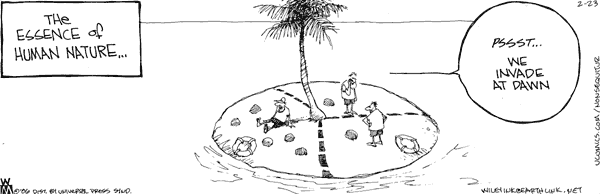
The Dilbert cartoon on the fungibility of oil was great, but when a cartoon can explain all that anyone needs to know about international politics, it's even better!!!!
What To Do In Darfur
Now here I do have some ideas. Following my last post on Darfur, Bush seems to be getting even more serious, and is suggesting that NATO take a more involved role in stopping the bloodshed in Darfur. It's about time. If anything should be done to help Darfur, waiting for the UN to help is absurd. It's time NATO gets involved, telling states that sovereignty is not a blanket protection from punishment for genocide or crimes against humanity. Power used in pursuit of liberal values is power well-used. The failure of the West to prevent the Rwandan genocide is one of the blackest marks on US foreign policy in recent history; let's not let it happen again.
A Papal Smackdown
Normally, I hate when the Vatican gets involved in politics, but today the Pope is right on. The Vatican today has urged Muslim nations upset by the Danish cartoons to practice religious toleration in their own countries. As the Reuters article points out "limits on Christians in some Islamic countries are far harsher than restrictions in the West that Muslims decry, such as France's ban on headscarves in state schools. Saudi Arabia bans all public expression of any non-Muslim religion and sometimes arrests Christians even for worshipping privately. Pakistan allows churches to operate but its Islamic laws effectively deprive Christians of many rights." These are the states that the US media is trying to appease and "understand."
What To Do In Iraq
No, I don't have the answer. But other people may. Alex Tabarrok over at Marginal Revolution informs us of an upcoming CSPAN program entitled Innovative Solutions for Iraq. The program features many smart people, including Lawrence Korb, Lt. Gen William Odem, and Peter Brookes, and will discuss:
The recent elections in Iraq have not resolved the main problems there—a constitutional crisis, continued terrorism, a potent Sunni rebellion, and fighting between religious and ethnic groups that could result in a full-blown civil war. Is the Iraq war a hopeless quagmire that has been lost, or can the U.S. still foster a united, peaceful and prosperous Iraq? If the latter, how can this be achieved? Should the Iraqi constitution be revised and, if so, how? Should the U.S. withdraw its forces—with Iraq partitioned—or use the threat of withdrawal to pressure Iraqi groups into a negotiated settlement? Should the U.S. extract troops rapidly, pull them out gradually, stay the course with current Bush administration policy, or escalate its involvement, as advocated by Senator John McCain? This very timely policy forum will address these thorny issues and propose varied and innovative solutions for Iraq.The forum will be broadcast on CSPAN Saturday, February 25, 9:00 p.m. ET (6:00 p.m. PT) and Monday, February 27, 6:20 a.m. ET (3:20 a.m. PT).
Wednesday, February 22, 2006
Sudan Rejects UN Peacekeepers
Shocking. Sudan has decided to block the UN from deploying peacekeepers into Darfur to protect the people who are being raped and killed by militias sponsored by the central government. There are currently 7,000 peacekeepers from the African Union in Darfur, but they have proven largely ineffective. Additionally, the UN estimates that nearly twice that number are needed to protect the Darfurians (?).
As I have said many times, the UN needs to decide between protecting sovereignty and protecting human rights. It just can't do both.
As I have said many times, the UN needs to decide between protecting sovereignty and protecting human rights. It just can't do both.
Hamas Settles In
Hamas has been asked by Palestinian President Mahmoud Abbas to form the next Palestinian government at the same that Israel has announced it will cease transferring collected tax revenues of about $50 a month to the Palestinians. Interestingly, Israeli Interim Prime Minister Ehud Olmert has chosen this moment to declare that Hamas does not pose a strategic threat to Israel.
I read Olmert's comments are paving the way for Israel to give Hamas some space to decide what kind of government it wants to create. By declaring that Hamas does not threaten the existence of Israel, Olmert is likely preparing Israel for the possibilities of dealing with a Hamas-led Palestinian government. A wise decision, I believe.
However, the decision to withhold the Palestinian tax revenue is unwise and threatens to force Hamas' hand. Hamas has already looked towards Iran to make up for the lost cash flow, and strangling the Palestinian people can only ramp up support for new violent attacks. Israel should resume the payments to the PA immediately, predicating the flow on the continued absence of terrorist attacks against Israel (and of course, threatening wide-scale military responses as well as continued separation). This would give Hamas both the incentive and the time to decide how it wants to deal with Israel. Note there has not been a resumption of suicide attacks, or any other uses of violence, by Hamas or Fatah since the election. Now is not the time for Israel to antagonize the situation. If Hamas is truly not a strategic threat as Olmert claims and I believe, then why not give Hamas the money until it screws up?
I read Olmert's comments are paving the way for Israel to give Hamas some space to decide what kind of government it wants to create. By declaring that Hamas does not threaten the existence of Israel, Olmert is likely preparing Israel for the possibilities of dealing with a Hamas-led Palestinian government. A wise decision, I believe.
However, the decision to withhold the Palestinian tax revenue is unwise and threatens to force Hamas' hand. Hamas has already looked towards Iran to make up for the lost cash flow, and strangling the Palestinian people can only ramp up support for new violent attacks. Israel should resume the payments to the PA immediately, predicating the flow on the continued absence of terrorist attacks against Israel (and of course, threatening wide-scale military responses as well as continued separation). This would give Hamas both the incentive and the time to decide how it wants to deal with Israel. Note there has not been a resumption of suicide attacks, or any other uses of violence, by Hamas or Fatah since the election. Now is not the time for Israel to antagonize the situation. If Hamas is truly not a strategic threat as Olmert claims and I believe, then why not give Hamas the money until it screws up?
Tuesday, February 21, 2006
Update on The Smoking Signature
Kevin Jon Heller over at Opinio Juris has an extremely important update on the trial of Saddam Hussein (damn these time zones...by the time I wake up, all the good stuff has already been blogged about!!). Last week, it looked as if the prosecution was introducing some hard evidence of Hussein's guilt: a memo signed by Saddam himself ordering the execution of 140 Shi'ites. Today, however, it's being reported that the memo is not quite so damning. Rather than an execution order the document shows "Saddam signing off on bonuses for security agents in the investigation of the assassination attempt and presidential approval of death sentences for residents of Dujail, north of Baghdad" and "Saddam's approval of a recommendation allegedly made by Barzan Ibrahim, his half brother and co-defendant, to reward intelligence officers for their "confrontation against subversive and armed elements ... in the Dujail area."
This is an excellent example of why it's going to be so hard to get guilty verdicts in this trial, as well as that of Slobodan Milosevic. As the AP reports, "Saddam's approval of death sentences handed down by the Revolutionary Court against Shiites from Dujail could not prove incriminating unless there is compelling evidence that Saddam knew the defendants were railroaded. Also, orders for arrests or transfers of detainees from one facility to another mean little unless the prosecution can prove that Saddam knew they would be tortured." As the sovereign ruler of Iraq, Hussein had a right and duty to protect his country, even through methods we might find repugnant. To find him guilty, the prosecutors have to show that Hussein knew what was going on and had a hand in ordering murders. It's simple enough for Hussein to claim that he was suppressing a rebellion and that if a few officers went beyond the call of duty and tortured or murdered a few Kurds or Shiites, Hussein had nothing to do with it. In the words of Saddam's attorney, "There is nothing in these documents that show anything beside President Saddam exercising his constitutional authorities. As president, he ratifies death sentences and approves promotions."
The chief prosecutor has announced that he does in fact have hard evidence, claiming "he would present a document during the next session, Feb. 28, involving communication between the intelligence agency and Saddam that he suggested would further tie Saddam directly to the Dujail crackdown." We'll see....
This is an excellent example of why it's going to be so hard to get guilty verdicts in this trial, as well as that of Slobodan Milosevic. As the AP reports, "Saddam's approval of death sentences handed down by the Revolutionary Court against Shiites from Dujail could not prove incriminating unless there is compelling evidence that Saddam knew the defendants were railroaded. Also, orders for arrests or transfers of detainees from one facility to another mean little unless the prosecution can prove that Saddam knew they would be tortured." As the sovereign ruler of Iraq, Hussein had a right and duty to protect his country, even through methods we might find repugnant. To find him guilty, the prosecutors have to show that Hussein knew what was going on and had a hand in ordering murders. It's simple enough for Hussein to claim that he was suppressing a rebellion and that if a few officers went beyond the call of duty and tortured or murdered a few Kurds or Shiites, Hussein had nothing to do with it. In the words of Saddam's attorney, "There is nothing in these documents that show anything beside President Saddam exercising his constitutional authorities. As president, he ratifies death sentences and approves promotions."
The chief prosecutor has announced that he does in fact have hard evidence, claiming "he would present a document during the next session, Feb. 28, involving communication between the intelligence agency and Saddam that he suggested would further tie Saddam directly to the Dujail crackdown." We'll see....
Monday, February 20, 2006
More on China and Google
Sunday's Washington Post had an excellent article about China and the censoring of the Internet. In short, the article argues that "widespread Internet use in [China's] largest cities and among the educated is changing the way Chinese learn about the world and weakening the Communist Party's monopoloy on the media." How is this possible? Doesn't the Chinese government censor the Internet? Doesn't Google help the Communist Party do this, in a nefarious attempt to make money at all costs?
The article writes that "the success of those [censorship] measures has been mixed. ...the Internet presents a formidable challenge to China's authoritarian political system." Just having access to the Internet, even if it's under governmental control, makes it more difficult to keep information out. And the more information flows into China, the better. So, as I've said before, chastising, punishing, or preventing Google from bringing the Internet into China, even if they have to collaborate with the Communist Party to do so, is extremely short-sighted.
The article writes that "the success of those [censorship] measures has been mixed. ...the Internet presents a formidable challenge to China's authoritarian political system." Just having access to the Internet, even if it's under governmental control, makes it more difficult to keep information out. And the more information flows into China, the better. So, as I've said before, chastising, punishing, or preventing Google from bringing the Internet into China, even if they have to collaborate with the Communist Party to do so, is extremely short-sighted.
Saturday, February 18, 2006
Friday, February 17, 2006
Darfur and Peacekeepers
Even people who typically dislike President Bush, like Nicholas Kristof, have grudingly tipped their hats to him on the issue of Darfur. Now, Bush seems to have stepped up to the plate in a big way, saying that twice the numbers of peacekeepers currently in Darfur will be needed to protect the people there, and the NATO should take a lead role. Things are still a long way from actually happening, but at least the talk is moving in the right direction.
The Definition of Terrorism
In an exceedingly interesting decision, an Italian appellate court has upheld the acquittals of three men accused of charges of international terrorism. Specifically, the men were accused of recruiting suicide bombers to strike against US soldiers in Iraq. The Italian judges held that the men could not be convicted as terrorists because terrorism involves "acts exclusively directed against a civilian population. The recruitment of volunteers in Iraq to fight against the Americans cannot be considered under any circumstance terrorist activity" Naturally, the decision has enraged ministers of the Italian government, leading the Justice Minister to apologize to victims of terrorism, and would certainly produce a similar reaction in the US, if anyone paid attention.
Is there something inherently wrong with the appellate court's ruling? Interestingly, I have been discussing this very question with my class The Politics of Terror here at the University of Puget Sound. If the concept of "terrorism" is to have any analytic meaning whatsoever, one must be able to distinguish "terrorism" from "not terrorism." After all, the word "terrorism" inherently means the illegitimate or illegal use of political violence, as opposed to the legitimate or legal use of the same.
If attacking soldiers occupying your country is not legitimate or legal, then there is no way in which political violence can be acceptable. To deem something legitimate is not to approve of it. I am a supporter of the war in Iraq and most certainly would prefer that the insurgents do not succeed. But that doesn't mean that I believe they are not justified in their actions. Terrorism must be defined by the means used to pursue a political goal, not the goal itself. A group pursuing a terrorist goal can use both legitimate and illegitimate means to pursue its goal. When Iraqi insurgents attack US soldiers, it's legitimate; when they attack schools or mosques, it's terrorism.
One caveat: the men acquitted by the Italian court were North African. In my mind, this changes things slightly...it's a matter of "standing." I'm not so sure if people not directly impacted by the occupation should have the "right" to legitimate political violence. If Sunni Iraqis are attacking US troopsin hopes of overthrowing the new regime and returning to power, fine. But I'm not so sure the definition works for outsiders more interested in causing chaos than creating a political alternative.
Is there something inherently wrong with the appellate court's ruling? Interestingly, I have been discussing this very question with my class The Politics of Terror here at the University of Puget Sound. If the concept of "terrorism" is to have any analytic meaning whatsoever, one must be able to distinguish "terrorism" from "not terrorism." After all, the word "terrorism" inherently means the illegitimate or illegal use of political violence, as opposed to the legitimate or legal use of the same.
If attacking soldiers occupying your country is not legitimate or legal, then there is no way in which political violence can be acceptable. To deem something legitimate is not to approve of it. I am a supporter of the war in Iraq and most certainly would prefer that the insurgents do not succeed. But that doesn't mean that I believe they are not justified in their actions. Terrorism must be defined by the means used to pursue a political goal, not the goal itself. A group pursuing a terrorist goal can use both legitimate and illegitimate means to pursue its goal. When Iraqi insurgents attack US soldiers, it's legitimate; when they attack schools or mosques, it's terrorism.
One caveat: the men acquitted by the Italian court were North African. In my mind, this changes things slightly...it's a matter of "standing." I'm not so sure if people not directly impacted by the occupation should have the "right" to legitimate political violence. If Sunni Iraqis are attacking US troopsin hopes of overthrowing the new regime and returning to power, fine. But I'm not so sure the definition works for outsiders more interested in causing chaos than creating a political alternative.
Thursday, February 16, 2006
The Smoking Signature
Over at Opinio Juris, guest-blogger Kevin Jon Heller calls our attention to an exceeding important and strangely under-reported article. On the website of the Australian Broadcasting Company is a report that prosecutors in the trial of Saddam Hussein have presented an execution order, signed by Hussein himself, ordering the killing of 140 Iraqi Shi'ites. If authentic, this would be the first piece of hard evidence directly connecting Saddam to mass killing. This is the hardest part of trials such as this and that of Slobodan Milosevic. It's one thing to know that massacres occured under the regime of this or that leader; it's another to prove that the leader knew of the massacres and in fact ordered them. It's simple enough for a dictator to argue that in the process of putting down an uprising or enforcing the law, a rogue officer or official ordered a massacre, unbeknownst to the political leader himself. This is why it is so critical to find smoking guns such as this alleged execution order.
What puzzles me is why there is so little media coverage of this. A web search turns up almost no mention of this development other than the ABC (the Aussie version) reports. I did find one CNN report that, buried in the middle of an article about Hussein's courtroom tantrums, mentioned that "documents -- such as signed execution orders signed by Hussein -- were put into evidence." This is a huge development...why is no one reporting about it?
What puzzles me is why there is so little media coverage of this. A web search turns up almost no mention of this development other than the ABC (the Aussie version) reports. I did find one CNN report that, buried in the middle of an article about Hussein's courtroom tantrums, mentioned that "documents -- such as signed execution orders signed by Hussein -- were put into evidence." This is a huge development...why is no one reporting about it?
Wednesday, February 15, 2006
The Spineless EU
In the wake of my post on the EU's effort to appease the Mulsims rioting against the Danish cartoons comes this article describing the EU's plans to support a proposal by the Organization of the Islamic Conference (OIC) to get the UN to action against "blasphemy." The OIC is lobbying to get language banning blasphemy or defaming religion included in the tenets of any new UN human rights body.
One would think that the EU would be hestitant to make concessions to states that fail to live up to the basic standards of liberal human rights, such as freedom of religion, freedom of the press and speech, and equality of women, for example. Just take a look at this map of freedom created by Freedom House. How many Islamic countries rate as free, or even partly free? Among states with Muslim majorities (46 countries), 3 rate as "Free," 20 as "PartlyFree," and 23 are "Not Free." However, EU High Representative for the Common Foreign and Security Policy Javier Solana sided with the OIC, saying that "We have been talking today on how we can send a message to the people in both communities, the Islamic and European, that we need this not to happen again ... We strongly hope that people will be now sensible to understand that. Be sure we are going to do our utmost for this not to happen again, because we need each other... I don't think honestly it will happen again."
Just to demonstrate that this is not a case of an official's personal views deviating from stated policy, Solana's chief of staff concurred: "[The Islamic states] want mechanisms to guarantee this is not repeated and we should be able to find it in UN conventions on human rights."
An unnamed EU official close to the talks between Solana and the OIC dissented, arguing that the EU had and would make no promises to the OIC on anti-blasphemy legislation. But, he went on to say that "We deviated from the word 'laws' and moved to concentrate on conventions, resolutions and such things. We have to be careful of Western public opinion." Ah yes, the European commitment to free speech and press is not a moral one, but merely a reflection of public opinion.
Actually, I hope that the EU's spineless appeasement succeeds. What better way to demonstrate the complete and total irrelevance of the UN than to have its human rights codes be stronger in preventing satiric criticism of religion than genocide or oppression? Such an act would truly consign the UN to the ashbin of history where human rights are concerned. Good riddance.
One would think that the EU would be hestitant to make concessions to states that fail to live up to the basic standards of liberal human rights, such as freedom of religion, freedom of the press and speech, and equality of women, for example. Just take a look at this map of freedom created by Freedom House. How many Islamic countries rate as free, or even partly free? Among states with Muslim majorities (46 countries), 3 rate as "Free," 20 as "PartlyFree," and 23 are "Not Free." However, EU High Representative for the Common Foreign and Security Policy Javier Solana sided with the OIC, saying that "We have been talking today on how we can send a message to the people in both communities, the Islamic and European, that we need this not to happen again ... We strongly hope that people will be now sensible to understand that. Be sure we are going to do our utmost for this not to happen again, because we need each other... I don't think honestly it will happen again."
Just to demonstrate that this is not a case of an official's personal views deviating from stated policy, Solana's chief of staff concurred: "[The Islamic states] want mechanisms to guarantee this is not repeated and we should be able to find it in UN conventions on human rights."
An unnamed EU official close to the talks between Solana and the OIC dissented, arguing that the EU had and would make no promises to the OIC on anti-blasphemy legislation. But, he went on to say that "We deviated from the word 'laws' and moved to concentrate on conventions, resolutions and such things. We have to be careful of Western public opinion." Ah yes, the European commitment to free speech and press is not a moral one, but merely a reflection of public opinion.
Actually, I hope that the EU's spineless appeasement succeeds. What better way to demonstrate the complete and total irrelevance of the UN than to have its human rights codes be stronger in preventing satiric criticism of religion than genocide or oppression? Such an act would truly consign the UN to the ashbin of history where human rights are concerned. Good riddance.
I've Said It Before, and I'll Say It Again...Democracy Just Doesn't Work
The above title are the oh-so-wise words of Springfield's top news anchor, Kent Brockman, but today we have an excellent example of Kent's point. Over at Opinio Juris, guest-blogger Kevin Jon Heller has a post pointing out that more people are confident in the UN's ability to handle the Iran nuclear crisis than in Bush's ability.
While it may be true that Bush has few good options in dealing with Iran, it's hard to see how anyone can have more faith in the UN. Is Beijing going to sacrifice more than $100 billion in energy deals with Iran to give the US and the West a political victory? Will Russia alienate one of its major arms clients? And even if the UN can convince Russia and China to get on board with a serious sanctions regime, does the experience of sanctioning Iraq provide any assurance that sanctions can work? Sanctions take an exceedingly long time to have any effect on the political leadership of a country, and the more direct effects are felt by the civilian population. Additionally, sanctions create huge collective action problem that encourage widespread defection and cheating. This means that sanctions are usually just strong enough to harm the public but insufficient to achieve the intended political outcome.
Also, let's consider the UN's track record in preventing countries from developing nuclear weapons? North Korea...no. Pakistan....no. India...no. Israel...no. South Africa...no (South Africa secretly developed a nuclear weapon, but dismantled its program voluntarily). Iran...not so far. Argentina and Brazil...no (these two countries were locked in a nuclear arms race, but created an agreement that has prevented the development of NW). The only possible success story is Iraq. But, without the Israeli strike on Osiraq and the US invasion in 1991, Iraq most certainly would have had nuclear weapons. Furthermore, let's not forget the outcries against the sanctions that killed so many Iraqi civilians. It's hard to imagine the world having the stomach to impose an ever harsher sanctions regime on Iran.
So, how can more Americans believe that the UN can solve this problem? It's hard to fathom. I'm not confident that the US will be able to find a nice solution, but the UN can't even stop the Sudanese government from slaughtering its people. How will it be able to stop Iran from getting nukes? Note in such an excellent oxymoron that the poll also notes that while 67% of Americans believe that Bush won't do enough to prevent Iran from getting nukes, 69% fear that Bush will be "too quick" to use force. Idiots. This is why we should be happy that foreign policy isn't made by the more subject-to-public-opinion congressmen and senators.
While it may be true that Bush has few good options in dealing with Iran, it's hard to see how anyone can have more faith in the UN. Is Beijing going to sacrifice more than $100 billion in energy deals with Iran to give the US and the West a political victory? Will Russia alienate one of its major arms clients? And even if the UN can convince Russia and China to get on board with a serious sanctions regime, does the experience of sanctioning Iraq provide any assurance that sanctions can work? Sanctions take an exceedingly long time to have any effect on the political leadership of a country, and the more direct effects are felt by the civilian population. Additionally, sanctions create huge collective action problem that encourage widespread defection and cheating. This means that sanctions are usually just strong enough to harm the public but insufficient to achieve the intended political outcome.
Also, let's consider the UN's track record in preventing countries from developing nuclear weapons? North Korea...no. Pakistan....no. India...no. Israel...no. South Africa...no (South Africa secretly developed a nuclear weapon, but dismantled its program voluntarily). Iran...not so far. Argentina and Brazil...no (these two countries were locked in a nuclear arms race, but created an agreement that has prevented the development of NW). The only possible success story is Iraq. But, without the Israeli strike on Osiraq and the US invasion in 1991, Iraq most certainly would have had nuclear weapons. Furthermore, let's not forget the outcries against the sanctions that killed so many Iraqi civilians. It's hard to imagine the world having the stomach to impose an ever harsher sanctions regime on Iran.
So, how can more Americans believe that the UN can solve this problem? It's hard to fathom. I'm not confident that the US will be able to find a nice solution, but the UN can't even stop the Sudanese government from slaughtering its people. How will it be able to stop Iran from getting nukes? Note in such an excellent oxymoron that the poll also notes that while 67% of Americans believe that Bush won't do enough to prevent Iran from getting nukes, 69% fear that Bush will be "too quick" to use force. Idiots. This is why we should be happy that foreign policy isn't made by the more subject-to-public-opinion congressmen and senators.
Tuesday, February 14, 2006
Helping Africa
US Speedskater Joey Cheek has announced that he will donate the $25,000 bonus he will receive from the US Olympic Committe for winning the gold in the 500m race to an organization that provides relief to children in Darfur. One must admire Cheek's cheek...speedskaters certainly don't make the big bucks, and one has to imagine that for him, $25,000 is a lot of money (as opposed to, say, hockey players, or even the big time skiiers and snowboarders with their endorsements). Furthermore, Cheek's action could go a long way in raising awareness of the problems in Sudan and encouraging even more people to help.
Still, one cannot help but think about (or at least I couldn't) this op-ed in the Washington Post by William Easterly, an NYU economist. Easterly writes that while things like the genocide in Darfur or the problem of AIDS and other infectious diseases are "tragedies that deserve attention, the obsessive and almost exclusive Western focus on them is less relevant to the vast majority of Africans -- the hundreds of millions not fleeing from homicidal minors, not HIV-positive, not starving to death, and not helpless wards waiting for actors and rock stars to rescue them. Angelina [Jolie, but feel free to insert Joey Cheek], the continent has problems but it is not being destroyed. This is not to say that all Western aid efforts in Africa are condemned to fail. Aid groups could search for achievable tasks with high potential for poor individuals to help themselves. To do so, they would have to subject themselves to independent evaluation and be accountable to the intended beneficiaries for the results. Such an approach would contrast with the prevailing norm of never holding anyone individually accountable for the results of traditional government-to-government aid programs aimed at feeding the hubristic fantasies of outside transformation of whole societies."
Good stuff.
Still, one cannot help but think about (or at least I couldn't) this op-ed in the Washington Post by William Easterly, an NYU economist. Easterly writes that while things like the genocide in Darfur or the problem of AIDS and other infectious diseases are "tragedies that deserve attention, the obsessive and almost exclusive Western focus on them is less relevant to the vast majority of Africans -- the hundreds of millions not fleeing from homicidal minors, not HIV-positive, not starving to death, and not helpless wards waiting for actors and rock stars to rescue them. Angelina [Jolie, but feel free to insert Joey Cheek], the continent has problems but it is not being destroyed. This is not to say that all Western aid efforts in Africa are condemned to fail. Aid groups could search for achievable tasks with high potential for poor individuals to help themselves. To do so, they would have to subject themselves to independent evaluation and be accountable to the intended beneficiaries for the results. Such an approach would contrast with the prevailing norm of never holding anyone individually accountable for the results of traditional government-to-government aid programs aimed at feeding the hubristic fantasies of outside transformation of whole societies."
Good stuff.
If You Ignore Them, Maybe They'll Go Away...
In the wake of the Danish cartoon saga, the best-selling newspaper in Iran has launched a contest for cartoons making fun of the Holocaust. Ostensibly, the contest is intended to test the limits of free speech in the West. In the words of the paper's publisher, "We do not want to make fun of anyone with this competition, we just want to raise a question to find an answer which is very important for us. We are not even after a historical discussion on the Holocaust. The West believes that the Holocaust is true and we suppose that if it is true, aren't we entitled to draw caricatures about it?" The head of Cartoon House, a website cooperating with the newspaper in the contest, added in response to protests by Jewish organizations and Western governments, ""It is surprising that they allow disrespect toward different religions with insulting pictures and there is no reaction to them in the West, but when people question the Holocaust, they adopt such a stance toward it."
The real question is: Why must anybody respond to this idiocy at all? Under any definition of free speech or freedom of the press, there is nothing inherently wrong with criticizing, or even mocking, the Holocaust or publishing cartoons that do so. [Please note that I think the ban on Holocaust denial in many European countries is a really bad idea, if only because an idiotic idea that the authorities need to ban is much more believable than an idiotic idea that can be exposed to the public.] Not that Iran has any level of free speech or freedom of the press. If these cartoonists dared insult Islam or the Iranian regime, you can be sure that they wouldn't be lauded by the Iranian president. Furthermore, what effect will protesting the contest have? It will provide grist for the mill on the Arab street, giving credence to the argument that the West has a double standard when it comes to Islam and Muslims. Also, protesting the cartoons will only call more attention to them and get them more publicity.
So, everyone should simply ignore this pathetic and moronic attempt by Iran to make a point about free speech. The more attention given to it, the worse it will become.
The real question is: Why must anybody respond to this idiocy at all? Under any definition of free speech or freedom of the press, there is nothing inherently wrong with criticizing, or even mocking, the Holocaust or publishing cartoons that do so. [Please note that I think the ban on Holocaust denial in many European countries is a really bad idea, if only because an idiotic idea that the authorities need to ban is much more believable than an idiotic idea that can be exposed to the public.] Not that Iran has any level of free speech or freedom of the press. If these cartoonists dared insult Islam or the Iranian regime, you can be sure that they wouldn't be lauded by the Iranian president. Furthermore, what effect will protesting the contest have? It will provide grist for the mill on the Arab street, giving credence to the argument that the West has a double standard when it comes to Islam and Muslims. Also, protesting the cartoons will only call more attention to them and get them more publicity.
So, everyone should simply ignore this pathetic and moronic attempt by Iran to make a point about free speech. The more attention given to it, the worse it will become.
Never Again?
NATO has announced that while it may be willing to assist peacekeepers in Darfur, either from the UN or the African Union, NATO is not prepared or willing to commit troops to help the situation on the ground in Darfur. There are several good reasons for this, including the increased number of NATO troops needed in Afghanistan.
However, on top of any logistical impediments to a NATO involvement, there also seems to be a philosophical objection as well; namely, the commitment to sovereignty that I've previously identified as the bugaboo of the UN. Many seem to doubt whether Sudan will allow US or NATO soldiers on its soil. The French are questioning whether NATO can be the "gendarme of the world." US Deputy Secretary of State Robert Zoellick stressed that African problems should have African solutions.
This is pathetic. A government that is massacring and ethnically cleansing its populations gets to decide whether peacekeepers can protect those people? That won't go far in preventing genocide. What meaning can international law have if sovereignty permits a government to block peacekeepers? How can the AU possibly hope to protect the people of Darfur? AU troops are woefully underfunded and undertrained, not to mention the political in-fighting that gets in the way of meaningful political improvement. And finally, if NATO, and the US in particular, won't act as the world's policemen, then who will?
The international community has to face up to a question. What is more important: adherence to the existing rules and norms, or commitment to the norms of liberalism, which are rapidly being seen as commensurate with the international system writ large? The two cannot co-exist. If the existing laws and norms are to prevail, then the protection and promotion sovereignty will be the international imperative, and people should simply stop talking about law and morals in international politics. If the international community truly wants to prevent genocide and promote human rights, then it needs to drop this knee-jerk commitment to the existing rules of the system and start punishing those who break the norms. If Sudan doesn't want peacekeepers to interfere with its genocide and ethnic cleansing in Darfur, should a belief in sovereignty enable that desire? If France is concerned with the well-being of Africans, should NATO do what it can to ensure those Africans aren't slaughtered?
The existing rules of the international system simply cannot coexist with a concern for human rights and preventing genocide.
However, on top of any logistical impediments to a NATO involvement, there also seems to be a philosophical objection as well; namely, the commitment to sovereignty that I've previously identified as the bugaboo of the UN. Many seem to doubt whether Sudan will allow US or NATO soldiers on its soil. The French are questioning whether NATO can be the "gendarme of the world." US Deputy Secretary of State Robert Zoellick stressed that African problems should have African solutions.
This is pathetic. A government that is massacring and ethnically cleansing its populations gets to decide whether peacekeepers can protect those people? That won't go far in preventing genocide. What meaning can international law have if sovereignty permits a government to block peacekeepers? How can the AU possibly hope to protect the people of Darfur? AU troops are woefully underfunded and undertrained, not to mention the political in-fighting that gets in the way of meaningful political improvement. And finally, if NATO, and the US in particular, won't act as the world's policemen, then who will?
The international community has to face up to a question. What is more important: adherence to the existing rules and norms, or commitment to the norms of liberalism, which are rapidly being seen as commensurate with the international system writ large? The two cannot co-exist. If the existing laws and norms are to prevail, then the protection and promotion sovereignty will be the international imperative, and people should simply stop talking about law and morals in international politics. If the international community truly wants to prevent genocide and promote human rights, then it needs to drop this knee-jerk commitment to the existing rules of the system and start punishing those who break the norms. If Sudan doesn't want peacekeepers to interfere with its genocide and ethnic cleansing in Darfur, should a belief in sovereignty enable that desire? If France is concerned with the well-being of Africans, should NATO do what it can to ensure those Africans aren't slaughtered?
The existing rules of the international system simply cannot coexist with a concern for human rights and preventing genocide.
Monday, February 13, 2006
The John Marshall of Palestine
In a very interesting development, the Palestinian parliament has created a constitutional court with the power of judicial review. The court will have the power to essentially veto legislation that is inconsistent with the Basic Law governing the Palestinian territories.
This court is of great concern to Hamas as it prepares to take control of the parliament. Specifically, the court will be able to overturn any religious laws that Hamas passes to move the territories closer to the rule of shari'a. The Basic Laws do state, in Article 4, that Islam is the official religion of the territories and that the source of all legislation shall be Islamic shari'a. However, the Palestinians have been largely resistant of any moves towards increased Islamic law in their domestic law.
Hamas will, upon taking control, try to overturn the creation of the court. If Hamas is not successful, the court could be a meaningful and important brake on the ambitions of Hamas and play a moderating role in Palestinian politics, as well as perhaps setting a precedent for other Arab and/or Islamic countries.
This court is of great concern to Hamas as it prepares to take control of the parliament. Specifically, the court will be able to overturn any religious laws that Hamas passes to move the territories closer to the rule of shari'a. The Basic Laws do state, in Article 4, that Islam is the official religion of the territories and that the source of all legislation shall be Islamic shari'a. However, the Palestinians have been largely resistant of any moves towards increased Islamic law in their domestic law.
Hamas will, upon taking control, try to overturn the creation of the court. If Hamas is not successful, the court could be a meaningful and important brake on the ambitions of Hamas and play a moderating role in Palestinian politics, as well as perhaps setting a precedent for other Arab and/or Islamic countries.
Friday, February 10, 2006
How To Deal With Hamas
The on-line version of the New York Times is reporting that France has seconded Russia's plan to invite leaders of Hamas to Russia to discuss the militant groups role in governing the Palestinian territories and advancing the peace process with Israel. Israel is, unsurprisingly, reacting badly to this news, with calls to withdraw the Israeli ambassador to Russia.
I was going to blog about the original piece in this morning's print edition reporting on Russia's plan (before the French got on board) by discussing the irrelevance of Russia on the international stage. Russia's role as a member of the Quartet (the US, EU, Russia, and the UN), like its status in the G-8, is an artifact of Russia's Cold War relevance. Now, as exemplified in Russia's recent failed attempt to leverage its natural gas power over Ukraine, Russia has little real power in international politics. How much difference has Russia made in the Israel-Palestinian peace process? None whatsoever (nor has the UN for that matter).
However, the more I thought about it, the more I think that these initial advances towards Hamas may be the right step. Forget the rhetoric about not rewarding terror: governments negotiate with and reward terrorists all the time. Just look at the PLO. The only relevant question is: What actions are most likely to lead towards a peaceful settlement of the crisis? Shutting out Hamas from the get-go will likely only alienate and polarize the Palestinian people even more. Reaching out to Hamas, combined with swift and vicious punishment and retaliation for any violent acts, can sufficiently engage Hamas and demonstrate the advantages to be gained by peaceful participation in the political process.
Ultimately, what difference does it make to Israel's security if Russia talks to Hamas? None whatsoever. Israel still has the capability to punish Hamas for any acts of terrorism. So who care if a few irrelevant countries choose to meet with them?
I was going to blog about the original piece in this morning's print edition reporting on Russia's plan (before the French got on board) by discussing the irrelevance of Russia on the international stage. Russia's role as a member of the Quartet (the US, EU, Russia, and the UN), like its status in the G-8, is an artifact of Russia's Cold War relevance. Now, as exemplified in Russia's recent failed attempt to leverage its natural gas power over Ukraine, Russia has little real power in international politics. How much difference has Russia made in the Israel-Palestinian peace process? None whatsoever (nor has the UN for that matter).
However, the more I thought about it, the more I think that these initial advances towards Hamas may be the right step. Forget the rhetoric about not rewarding terror: governments negotiate with and reward terrorists all the time. Just look at the PLO. The only relevant question is: What actions are most likely to lead towards a peaceful settlement of the crisis? Shutting out Hamas from the get-go will likely only alienate and polarize the Palestinian people even more. Reaching out to Hamas, combined with swift and vicious punishment and retaliation for any violent acts, can sufficiently engage Hamas and demonstrate the advantages to be gained by peaceful participation in the political process.
Ultimately, what difference does it make to Israel's security if Russia talks to Hamas? None whatsoever. Israel still has the capability to punish Hamas for any acts of terrorism. So who care if a few irrelevant countries choose to meet with them?
Thursday, February 09, 2006
If You Can't Beat 'Em...Appease 'Em!!
I have avoided blogging about the Islam-cartoon issue as there were already so many people commenting on it, and I didn't really have anything new to add. Until today.
The EU is considering creating a media code of conduct that would "urge the media to respect all religious sensibilities." EU Justice and Security Commissioner Franco Frattini claims that by adopting the code, the media will "give the Muslim world the message: We are aware of the consequences of exercising the right of free speech. We can and we are ready to self-regulate that right."
I find the EU's proposal shameful. Why does the European press need to acknowledge that they are aware of the consequences of exercising the right of free speech? Have the rioting Muslims been made aware of the consequences of burning embassies, killing priests, or even of exercising the right of free speech in threatening to behead those with whom they disagree? Whether or not the cartoons should have been run is a difficult question. But to ask the press to self-regulate in order to not offend groups of people willing to raze, threaten, and kill is another entirely. And here, the EU is giving the wrong answer. Were the cartoons offensive? Probably. But to allow the threats and violence of these lunatics to dictate how and what should be printed in disgraceful.
I was not aware that cheese-eating surrender monkeys lived in Italy (Frattini is a former Italian foreign minister) as well as in France.
UPDATE: Andrew Sullivan points out that the offending cartoons were printed on the front page of an Egyptian newspaper last October, and no riots ensued. As he writes, "this whole affair is a contrived, manufactured attempt by extremist Muslims to move the goal-posts on Western freedom. They're saying: we determine what you can and cannot print; and there's a difference between what Muslims can print and what infidels can print. And, so far, much of the West has gone along. In this, well-meaning American editors have been played for fools and cowards."
The EU is considering creating a media code of conduct that would "urge the media to respect all religious sensibilities." EU Justice and Security Commissioner Franco Frattini claims that by adopting the code, the media will "give the Muslim world the message: We are aware of the consequences of exercising the right of free speech. We can and we are ready to self-regulate that right."
I find the EU's proposal shameful. Why does the European press need to acknowledge that they are aware of the consequences of exercising the right of free speech? Have the rioting Muslims been made aware of the consequences of burning embassies, killing priests, or even of exercising the right of free speech in threatening to behead those with whom they disagree? Whether or not the cartoons should have been run is a difficult question. But to ask the press to self-regulate in order to not offend groups of people willing to raze, threaten, and kill is another entirely. And here, the EU is giving the wrong answer. Were the cartoons offensive? Probably. But to allow the threats and violence of these lunatics to dictate how and what should be printed in disgraceful.
I was not aware that cheese-eating surrender monkeys lived in Italy (Frattini is a former Italian foreign minister) as well as in France.
UPDATE: Andrew Sullivan points out that the offending cartoons were printed on the front page of an Egyptian newspaper last October, and no riots ensued. As he writes, "this whole affair is a contrived, manufactured attempt by extremist Muslims to move the goal-posts on Western freedom. They're saying: we determine what you can and cannot print; and there's a difference between what Muslims can print and what infidels can print. And, so far, much of the West has gone along. In this, well-meaning American editors have been played for fools and cowards."
Wednesday, February 08, 2006
The Future of the US Military
Max Boot has an fascinating piece in today's LA Times about the future of the US military. The problem he identifies is nothing new, but is even more relevant today. The problem is that the things the military likes and wants are not necessarily the military needs. Specifically, the recently announced defense budget contains funding for three next-generation short-range fighters -- the F/A-22 Raptor (US Air Force), the F/A-18 Super Hornet (US Navy), and the F-35 Joint Strike Fighter (multi-service). The Quadrennial Defense Review (a overhaul of defense strategy and planning that provides guidance for procurement and force configuration) calls for a shrinking of the US Army from 491,000 active duty soldiers to 482,400 in 2011 (in 1991 there were 710,000). The budget also includes funding for increased purchases of Virginia-class nuclear attack submarines. Left behind are such items as language and cultural training -- which Boot points out receive less than $181 million which is "less than the cost of one F-35."
The real problem is that the military is wedded in multiple ways to its high-tech toys, even if they are not well-suited to the battlefield of the future. Short-range fighters are particularly problematic, as the US is withdrawing from its forward-deployed air bases, and has increasing difficulty obtaining over-flight rights. Heavy naval ships, while capable of lobbing cruise missiles at distant targets, are designed to fight the now-non-existant Soviet surface navy. The most likely future challenger to US military might -- China -- has shown little interest in fielding a true blue-water navy. As we have seen, future military campaigns are much more likely to resemble Afghanistan and Iraq than World War II. What are needed are boots on the ground (soldiers) trained not only in infantry tactics but guerrilla/urban warfare, police duty, and language/culture, long-range precision-strike capabilities, special forces, and things like that.
The military is, however, reticent to accept such changes. A telling example: When I worked for SAIC back in the mid-1990s, I was running a wargame examining the future of the Air Force by looking at different possible configurations for the air force, including an entirely unmanned air force that used drones. The Air Force officers present at the game were almost incapable of playing the game as they just could not accept even the possibility that pilots might, someday, become unnecessary. Also, as Boot notes, Congress prefers to fund big-ticket, high-tech weapons that provide jobs in their districts.
This is going to be a problem. Even taking into account China, the US is not likely to find itself in a WWII- or WWIII-type conflict in the forseeable future. Smaller operations against other rogue states (and no, I'm not naming Iran or North Korea here) or humanitarian interventions are much more likely to demand a US military presence. The US needs lots of soliders combined with the ability to precisely strike targets at long distances to deal with these kind of problems. Of course, the US needs to maintain air and naval superiority, if only to deter others from even trying to develop such capabilities. But that can be occurred at a much cheaper price than is currently laid out in the new budget or the QDR.
The real problem is that the military is wedded in multiple ways to its high-tech toys, even if they are not well-suited to the battlefield of the future. Short-range fighters are particularly problematic, as the US is withdrawing from its forward-deployed air bases, and has increasing difficulty obtaining over-flight rights. Heavy naval ships, while capable of lobbing cruise missiles at distant targets, are designed to fight the now-non-existant Soviet surface navy. The most likely future challenger to US military might -- China -- has shown little interest in fielding a true blue-water navy. As we have seen, future military campaigns are much more likely to resemble Afghanistan and Iraq than World War II. What are needed are boots on the ground (soldiers) trained not only in infantry tactics but guerrilla/urban warfare, police duty, and language/culture, long-range precision-strike capabilities, special forces, and things like that.
The military is, however, reticent to accept such changes. A telling example: When I worked for SAIC back in the mid-1990s, I was running a wargame examining the future of the Air Force by looking at different possible configurations for the air force, including an entirely unmanned air force that used drones. The Air Force officers present at the game were almost incapable of playing the game as they just could not accept even the possibility that pilots might, someday, become unnecessary. Also, as Boot notes, Congress prefers to fund big-ticket, high-tech weapons that provide jobs in their districts.
This is going to be a problem. Even taking into account China, the US is not likely to find itself in a WWII- or WWIII-type conflict in the forseeable future. Smaller operations against other rogue states (and no, I'm not naming Iran or North Korea here) or humanitarian interventions are much more likely to demand a US military presence. The US needs lots of soliders combined with the ability to precisely strike targets at long distances to deal with these kind of problems. Of course, the US needs to maintain air and naval superiority, if only to deter others from even trying to develop such capabilities. But that can be occurred at a much cheaper price than is currently laid out in the new budget or the QDR.
Monday, February 06, 2006
Now THAT'S Stealthy
If you are a user of Google Earth (and if you're not, you should be...what a great way to waste time), enter these coordinates into the search bar: 34.637371, -118.082052
As my friend Geoff says, "Um, so we’re not supposed to be able to see those, right?"
As my friend Geoff says, "Um, so we’re not supposed to be able to see those, right?"
The Senate Hearing on NSA Surveillance
Attorney General Alberto Gonzalez is before a Senate panel today, testifying on the legality of the NSA's eavesdropping program. Gonzalez is still primarily relying on the argument that the nation is at war and that the congressional authorizations to use military force against al-Qaeda in Afghanistan and Iraq are sufficient legal authorization for the domestic spying. I do not find this logic persuasive and I do not believe that the Supreme Court (if and when this case gets there) will either.
There is a difference between a declaration of war and an authorization to use force that is significant and relevant, and it would be, in fact, counter-productive for the administration to go to far down this path. Congress is clearly and explicitly given the power to declare war by the Constitution. The president is clearly and explicitly given the power to command the nation's armed forces in the role of commander-in-chief. Even in the face of the War Powers Resolution, president after president has claimed authority to deploy force, even in the absence of a formal declaration of war or even congressional authorization, to meet the demands of national security.
Now, the administration is arguing that an authorization of force is the same thing as a declaration of war. This seems to limit, rather than expand, the president's authority to deploy military force, as it expands the definition of "declare war" beyond what presidents have previously accepted. This strategy, seems to me, to be extremely short-sighted. The congressional-executive war powers balance has evolved through the twin precedents of presidents claiming more power and Congress ceding its responsibility and acquiescing to the presidents' claims. President Bush is giving some of that ground back to Congress, setting the stage for a more aggressive Congress to possibly assert that, in an expansive view of congressional war powers, it should have authority, a la the War Powers Resolution, to oversee each and all deployments of US troops abroad.
There is a difference between a declaration of war and an authorization to use force that is significant and relevant, and it would be, in fact, counter-productive for the administration to go to far down this path. Congress is clearly and explicitly given the power to declare war by the Constitution. The president is clearly and explicitly given the power to command the nation's armed forces in the role of commander-in-chief. Even in the face of the War Powers Resolution, president after president has claimed authority to deploy force, even in the absence of a formal declaration of war or even congressional authorization, to meet the demands of national security.
Now, the administration is arguing that an authorization of force is the same thing as a declaration of war. This seems to limit, rather than expand, the president's authority to deploy military force, as it expands the definition of "declare war" beyond what presidents have previously accepted. This strategy, seems to me, to be extremely short-sighted. The congressional-executive war powers balance has evolved through the twin precedents of presidents claiming more power and Congress ceding its responsibility and acquiescing to the presidents' claims. President Bush is giving some of that ground back to Congress, setting the stage for a more aggressive Congress to possibly assert that, in an expansive view of congressional war powers, it should have authority, a la the War Powers Resolution, to oversee each and all deployments of US troops abroad.
Thursday, February 02, 2006
Revenge of the Cheese-Eating Surrender Monkeys!!
In today's Guardian, Timothy Garton Ash has a post about why the international community needs to create "a new international system for the supervision and inspection of nuclear capacities in every country in the world. It should be explicit, consistent and administered by the nearest thing we have to a world arbiter, the United Nations. In order for it to be credible, established nuclear powers such as Britain and the US will have to submit themselves to the same regime of supervision and inspection as everyone else."
The title of this post comes not only from an excellent episode of The Simpsons, but from Ash's assertion that the French, by virtue of Chirac's veiled threat to use nuclear force in response to terrorism, have become tougher than the US, which Ash believes has seen the light by recognizing that "the only serious answer [to the problem of Iran's nuclear program] coming from Washington is multilateral diplomacy, preferably through the UN. Welcome to the Euroweenies club, Mr President!"
I doubt the logic here, but even if Ash is correct, how can he possibly put his faith in the UN to solve this problem? Is there not an international institution known as the IAEA, of which Iran is a member, that has the power to control nuclear material and punish countries for violating the rules? Is there not an international institution known as the UN which has the power to enforce on a global scale the rules of the IAEA? Ash's solution is tantamount to announcing that while the UN has failed and will never work, the solution is to simply keep trying.
The UN's problems and inability to solve difficult problems like this are not in its scope, but in its design. Having 5 nations that possess opposing understandings of international security and national interest responsible for making policy -- and giving each the power to prevent anything from happening -- is a recipe for an unworkable solution. Why does Ash have any hope that a new institution could be better? If it is to be made stronger and more binding, the powerful states won't join it. If it looks like the UN, preserving the sovereignty of all, then what's the point?
The only solutions to the problem rest with either unilateral or small-scale multilateral action (like NATO) or in creating an institution that is not as inclusive as the UN and thus can actually make decisions, pass judgments, and enforce its rules. Recreating the UN is simply a fool's errand.
The title of this post comes not only from an excellent episode of The Simpsons, but from Ash's assertion that the French, by virtue of Chirac's veiled threat to use nuclear force in response to terrorism, have become tougher than the US, which Ash believes has seen the light by recognizing that "the only serious answer [to the problem of Iran's nuclear program] coming from Washington is multilateral diplomacy, preferably through the UN. Welcome to the Euroweenies club, Mr President!"
I doubt the logic here, but even if Ash is correct, how can he possibly put his faith in the UN to solve this problem? Is there not an international institution known as the IAEA, of which Iran is a member, that has the power to control nuclear material and punish countries for violating the rules? Is there not an international institution known as the UN which has the power to enforce on a global scale the rules of the IAEA? Ash's solution is tantamount to announcing that while the UN has failed and will never work, the solution is to simply keep trying.
The UN's problems and inability to solve difficult problems like this are not in its scope, but in its design. Having 5 nations that possess opposing understandings of international security and national interest responsible for making policy -- and giving each the power to prevent anything from happening -- is a recipe for an unworkable solution. Why does Ash have any hope that a new institution could be better? If it is to be made stronger and more binding, the powerful states won't join it. If it looks like the UN, preserving the sovereignty of all, then what's the point?
The only solutions to the problem rest with either unilateral or small-scale multilateral action (like NATO) or in creating an institution that is not as inclusive as the UN and thus can actually make decisions, pass judgments, and enforce its rules. Recreating the UN is simply a fool's errand.
Victories for Free Trade (and for International Law?)
Over at Opinio Juris, Julian Ku has a post lauding the decisions by the US to comply with two WTO decisions by scrapping cotton subsidies and by repealing the Byrd Amendment, which "transferred dumping duties on foreign companies to their domestic competitors." Julian ends by claiming that the decisions "demonstrate that yes, the U.S. does sometimes comply with international tribunal decisions, as long as there is political will to do so."
There is no doubt that these decisions are victories for free trade, but I am not as convinced that they represent the advance of international law. One must be careful to distinguish between cooperation under law and coordination of interests. While the WTO does have enforcement powers, it is an organization that represents coordination of interests, rather than real compulsion. That is, the member states believe that free trade is in their long-term, over-all national interest. However, free trade in particular is often hijacked and held hostage by collective action problems. This is why protectionism is able to remain such a powerful force, despite the glaring and massive economic inefficiencies it produces. The US would prefer to comply with the dictates of free trade but often finds it difficult to do so due to reasons of domestic politics. The WTO serves, in essence, as a "hands-tying" organization that binds the US to a course of action. When domestic politics gets in the way of free trade, the US can point to the WTO and argue that there is no choice but to comply.
Institutions can, of course, have meaningful political effects. In particular, by coordinating actions, decreasing information asymmetries, and permitting states to bind their hands and avoid collective action problems. But that's not quite the same thing as arguing that they represent real, hard international law. Law requires that states are prohibited from doing things that they would prefer to do and that they will be punished if they do those things. Most institutions do not operate this way. Rather, they help states cooperate to get what they all want anyway. International legal institutions that do not operate this way more often than not do not work (the NPT, the IAEA). Note this also explains why obtaining membership in the WTO (a trade organization with very difficult accession rules) is more difficult than in the NPT (any nation can sign): the member states of the WTO must be exceedingly careful not to let a fox in the henhouse.
There is no doubt that these decisions are victories for free trade, but I am not as convinced that they represent the advance of international law. One must be careful to distinguish between cooperation under law and coordination of interests. While the WTO does have enforcement powers, it is an organization that represents coordination of interests, rather than real compulsion. That is, the member states believe that free trade is in their long-term, over-all national interest. However, free trade in particular is often hijacked and held hostage by collective action problems. This is why protectionism is able to remain such a powerful force, despite the glaring and massive economic inefficiencies it produces. The US would prefer to comply with the dictates of free trade but often finds it difficult to do so due to reasons of domestic politics. The WTO serves, in essence, as a "hands-tying" organization that binds the US to a course of action. When domestic politics gets in the way of free trade, the US can point to the WTO and argue that there is no choice but to comply.
Institutions can, of course, have meaningful political effects. In particular, by coordinating actions, decreasing information asymmetries, and permitting states to bind their hands and avoid collective action problems. But that's not quite the same thing as arguing that they represent real, hard international law. Law requires that states are prohibited from doing things that they would prefer to do and that they will be punished if they do those things. Most institutions do not operate this way. Rather, they help states cooperate to get what they all want anyway. International legal institutions that do not operate this way more often than not do not work (the NPT, the IAEA). Note this also explains why obtaining membership in the WTO (a trade organization with very difficult accession rules) is more difficult than in the NPT (any nation can sign): the member states of the WTO must be exceedingly careful not to let a fox in the henhouse.
Wednesday, February 01, 2006
The UN in Darfur: Too Little, Too Late
The International Crisis Group has called on the US to use its month-long stint as the president of the UN Security Council to press for a UN force to replace the African Union peacekeepers in Darfur. Ah yes...now is such an excellent time for the UN to step in. While it is difficult to estimate how many people have died in Darfur so far, the US Department of State estimates that as of April of 2005 70,000 people had died due to the ethnic genocide being waged by the Islamic Arab north against the black Christians, animists, and tribalists in the south. [Ed: As pointed out in the comments, the Sudanese in Darfur are mostly, although not all, Muslim, so the conflict is not one of Islam against Christians. It is, however, Arab versus black. Thanks for the note, anonymous.] Many other analysts believe that the true count could be much higher -- as much as 4-5 times greater -- with high estimates ranging around 400,000 deaths. This does not include the 2,000,000 people estimated to have fled their homes. (Sorry the data is so old...if anyone knows of more recent numbers, please let me know.)
So yes, now is the time to get the UN involved. Where was it for the past few years, while tens if not hundreds of thousands of people were being killed, raped, forced from their homes, and otherwise brutalised? Placing the hopes of a people for justice and salvation in the UN, or the AU for that matter, is akin to believing in the Tooth Fairy. Unfortunately, while belief in the Tooth Fairy might net a kid a buck or so, trusting the UN usually produces indifference to, if not the outright abetting of (as in Srebrenica), genocide.
UPDATE: Case in point, the money quote from the ICG statement: While the AU troops have done much to provide security in Darfur they have been unable to protect civilians throughout the region. The AU forces have lacked manpower and resources and the Sudanese government has not cooperated with their mission. I hope this leaves you as dumb-struck as I am. If the AU has been unable to protect civilians, lacks manspower and resources, and has not had cooperation from the Sudanese government, how can it be claimed that "AU troops have done much to provide security"?
UPDATE, PART 2: The US has, in fact, called for the UN to deploy troops into Darfur. The article cited mentions the 2 million displaced persons, but does not mention numbers of dead or raped. It also notes that if the African Union and Khartoum do not agree to allow the UN to replace the AU troops, China will likely not consent to any operation (China gets a large amount of oil from Sudan and has long been a political protector of the regime). And, continuing the look at money quotes exemplifying the inability of the UN to deal with these kind of problems (note the use of my chosen title for the original blog post in the quote from Pronk):
So yes, now is the time to get the UN involved. Where was it for the past few years, while tens if not hundreds of thousands of people were being killed, raped, forced from their homes, and otherwise brutalised? Placing the hopes of a people for justice and salvation in the UN, or the AU for that matter, is akin to believing in the Tooth Fairy. Unfortunately, while belief in the Tooth Fairy might net a kid a buck or so, trusting the UN usually produces indifference to, if not the outright abetting of (as in Srebrenica), genocide.
UPDATE: Case in point, the money quote from the ICG statement: While the AU troops have done much to provide security in Darfur they have been unable to protect civilians throughout the region. The AU forces have lacked manpower and resources and the Sudanese government has not cooperated with their mission. I hope this leaves you as dumb-struck as I am. If the AU has been unable to protect civilians, lacks manspower and resources, and has not had cooperation from the Sudanese government, how can it be claimed that "AU troops have done much to provide security"?
UPDATE, PART 2: The US has, in fact, called for the UN to deploy troops into Darfur. The article cited mentions the 2 million displaced persons, but does not mention numbers of dead or raped. It also notes that if the African Union and Khartoum do not agree to allow the UN to replace the AU troops, China will likely not consent to any operation (China gets a large amount of oil from Sudan and has long been a political protector of the regime). And, continuing the look at money quotes exemplifying the inability of the UN to deal with these kind of problems (note the use of my chosen title for the original blog post in the quote from Pronk):
"Looking back at three years of killings and (ethnic) cleansing in Darfur, we must admit that our peace strategy so far has failed," Jan Pronk, the top U.N. envoy in Khartoum, said in mid-January. "All we did was picking up the pieces and muddling through, doing too little too late," he told the Security Council.
Egypt and Hamas
Egyptian officials are calling on Hamas to recognize Israel and disarm its militant wing. Of course, this likely has more to do with Egypt's fear of Hamas' influence on the Muslim Brotherhood in Egypt than out of any real concern for the security of Israel. Nonetheless, most of the politically relevant Arab nations with any influence over the peace process have issues with militant Islamic groups becoming involved in domestic politics. Jordan, Egypt, and Saudi Arabia all would likely prefer not to see Hamas continue its violent campaign against Israel lest it encourage domestic groups in their own countries to adopt a similar tactic. Such pressure from Arab nations could certainly help push Hamas towards a political strategy that would help support the struggling peace process.
In another note, Fatah and the PA are officially denying a claim by Egypt that the PA has agreed that Hamas would have to recognize Israel in order to join a Palestinian government. While it's too early to tell which claim is accurate, it certainly wouldn't be surprising for the PA and Fatah to publicly deny this, for the sake of domestic opinion, even if it is in fact true.
Overall, the pressure is mounting on Hamas to restrain itself and move towards becoming a legitimate political player.
UPDATE: Apparently, as I predict above, Saudi Arabia and Jordan have already begun pressuring Hamas to to moderate its stand towards Israel, work with Fatah, and continue the peace process.
In another note, Fatah and the PA are officially denying a claim by Egypt that the PA has agreed that Hamas would have to recognize Israel in order to join a Palestinian government. While it's too early to tell which claim is accurate, it certainly wouldn't be surprising for the PA and Fatah to publicly deny this, for the sake of domestic opinion, even if it is in fact true.
Overall, the pressure is mounting on Hamas to restrain itself and move towards becoming a legitimate political player.
UPDATE: Apparently, as I predict above, Saudi Arabia and Jordan have already begun pressuring Hamas to to moderate its stand towards Israel, work with Fatah, and continue the peace process.
The State of the Union Address and the Immutable Law of Speeches by Public Officials
I will not be blogging about the State of the Union address. First, plenty of other people have plenty to say. Second, I firmly believe in the Immutable Law of Speeches by Public Officials: the higher-ranking the official, the less interesting the speech. High-ranking public officials can't commit themselves to saying anything interesting in speeches, as things they say can have serious impact and consequences. The State of the Union Address -- and not just last nights -- is a platitudinous affair, in which the president says all kinds of nice things about what he wants to do, but offers no means of achieving those goals. Listening to a president speak, with very few exceptions such as when a major policy is going to be announced, is about as interesting as watching paint dry.
Justice and the Trial of Saddam Hussein
As I wrote about a while back over at Opinio Juris, the on-going trial of Saddam Hussein contains a tension between differing conceptions of justice. On the one hand is procedural justice: the desire to show the world that the rule of law and procedure is what creates a free society; on the other hand is retibutive justice: the need to punish Saddam for his heinous (and obvious) crimes. Personally, I believe that the latter is the more critical imperative here. In cases like this one, or the trial of Slobodan Milosevic in the Hague, the procedural rules and burden of proof make it exceedingly difficult to punish dictators for their crimes.
Now we find that Hussein is boycotting his trial. According to Hussein's lead lawyer, Hussein and the other co-defendants will refuse to appear in court until the lead judge, an ethnic Kurd, is removed from the bench. This is nothing new. Saddam has repeatedly interrupted the trial with ridiculous claims of abuse, political and religious tirades and rants, and refusals to cooperate with the court.
I fail to see how this is advancing justice in any way. The lead judge is apparently "considering" a request from the prosecutors to compel the defendants to appear. "Considering?" Hussein should be bound and gagged and forced to sit in court as his crimes are laid before the bench. He should not be allowed to interrupt the procedings (note that Milosevic has adopted a similiar strategy, which has caused his trial to drag on for several years). Witnesses should present the evidence, and Hussein should only be allowed to speak in direct rebuttal of any charges. Any thing else, even in the name of legal procedure, is a gross violation of the need for retributive justice. Domestic law, with its emphasis on procedural justice, is not well suited to dealing with such crimes. Allowing Saddam to walk free because the chain of command linking him to torture or genocide cannot be demonstrated is not an acceptable option.
Now we find that Hussein is boycotting his trial. According to Hussein's lead lawyer, Hussein and the other co-defendants will refuse to appear in court until the lead judge, an ethnic Kurd, is removed from the bench. This is nothing new. Saddam has repeatedly interrupted the trial with ridiculous claims of abuse, political and religious tirades and rants, and refusals to cooperate with the court.
I fail to see how this is advancing justice in any way. The lead judge is apparently "considering" a request from the prosecutors to compel the defendants to appear. "Considering?" Hussein should be bound and gagged and forced to sit in court as his crimes are laid before the bench. He should not be allowed to interrupt the procedings (note that Milosevic has adopted a similiar strategy, which has caused his trial to drag on for several years). Witnesses should present the evidence, and Hussein should only be allowed to speak in direct rebuttal of any charges. Any thing else, even in the name of legal procedure, is a gross violation of the need for retributive justice. Domestic law, with its emphasis on procedural justice, is not well suited to dealing with such crimes. Allowing Saddam to walk free because the chain of command linking him to torture or genocide cannot be demonstrated is not an acceptable option.
Subscribe to:
Posts (Atom)


 Posts
Posts