As Hamas attempts to reduce the power of Palestinian Prime Minister Mahmoud Abbas and Fatah storms out of the Palestinian parliament, Israel seems to be proceeding along the guidelines set out by now-stricked Prime Minister Ariel Sharon. A top ally of Ehud Olmert, the leader of Sharon's Kadima party and the expected winner of this month's parliamentary elections, has revealed that Olmert plans, if Kadima forms the next Israeli government as expected, to withdraw Israelis from many West Bank settlements and begin formalizing the process of separation from the Palestinians by finalizing the border on the West Bank. It is expected that any Israeli withdrawal would parallel the security wall being built between Israel and the West Bank.
Normally, such a revelation would be met by howls of protest from Fatah, complaining that Israel was attempting to set the final borders of a Palestinian state, and was doing so with less land than the pre-1967 borders would give. Interestingly, Hamas greeted this announcement with aplomb, stating "let them withdraw." There are likely two reasons for this reaction. First, Hamas tends to benefit from unilateral Israeli withdraws, as they are able to claim that their use of violence is what has induced Israel to give up land without reciprocal concessions. However, Hamas may also be simply smarter than Fatah has been. Hamas may recognize that Israel is unlikely to give up much more land than this withdrawal would cover and that securing an Israeli withdrawal and governing a newly-independent (or at least autonomous...the Israeli source claims that any withdrawal will not initially involve a military pullback as did Gaza) Palestinian state would be the best way to bury Fatah politically. If Hamas can deliver what Fatah could not, Arafat's legacy may be all but over.
Additionally, in the same article as Olmert's plan is discussed is an interesting nugget that has received no attention: A senior leader of Hamas telling Agence France-Presse that "Hamas must change its manners -- we know that very well." This is the first indication that Hamas has recognized the demands being made on it by the international community, and the first sign that Hamas is listening.
Monday, March 06, 2006


Friday, March 03, 2006
Will Hamas Change Its Stripes?
Russia has warned Hamas that the Palestinian group will have no future if it fails to transform itself into a legitimate political party. This is exactly the kind of pressure that should be placed on Hamas. I have written in earlier posts that Israel and other international actors should not marginalize and ostracize Hamas immediately, but rather should make it clear on what future interactions will depend: a cessation of violence by Hamas at a minimum, moving towards eventual recognition. If Hamas meets these terms, then Russia, Israel, the US, and other actors should deal with Hamas in the same way they did the PLO.
Thursday, March 02, 2006
India, Nuclear Proliferation, and Moral Hazard
President Bush is in India today to finalize an agreement that allows India access to the international nuclear regime in exchange for India allowing international inspections of its nuclear program. Since India has been outside of the Nuclear Non-Proliferation Treaty, it had been denied international assistance, expertise, and fuel as punishment. However, that also meant that India's nuclear program was not under the watchful eye of the International Atomic Energy Agency, or any other inspection regime. Now, both situations will change.
It's not entirely clear that Congress will agree to this deal, as there is concern that allowing India into the international nuclear consortium is a reward for illegal proliferation. That is, the NPT and IAEA, and all of the nuclear technology-sharing programs exist to deter countries from proliferating with the incentive of assistance for a peaceful nuclear program. If India is allowed to proliferate, and then is allowed in "the club" regardless, what incentive is there not to proliferate in the first place? To avoid the problem of moral hazard (encouraging risky behavior by guarding against the negative consequences of that action in the first place; an example: How fast would you drive if you had no auto or health insurance?), the US must not reward India for its proliferation.
The problem is that evaluating this case solely in the light of moral hazard ignores the more important political considerations. Is there any evidence that states that want nuclear weapons can be induced to forgo them to receive the benefits of NPT or IAEA membership? Not really. The countries that have disarmed (South Africa and former SSRs) or have chosen to avoid proliferating (Taiwan, Brazil, Argentina) have done so not out of fear of international sanction but for their own policy reasons. Does either Iran or North Korea seem likely to step back from the proliferation threshold so as to get access to peaceful nuclear technology? Will any country that doesn't have a policy-based interest in NW develop them because India was allowed to get away with it? Nukes are pricey, risky, dangerous, and bring all kinds of other opprobrium with them (it took India 10 years to shake the stigma of its decision to proliferate). Furthermore, India, unlike Iran or North Korea, never signed the NPT. Punishing India only increases the likelihood of a nuclear accident and undermines the burgeoning deterrent relationship between India and Pakistan. Congress should without hesitation approve this deal.
UPDATE: The IAEA has endorsed this deal, saying that "it would be a milestone, timely for ongoing efforts to consolidate the non-proliferation regime, combat nuclear terrorism and strengthen nuclear safety." Normally, this would be the strongest recommendation to run the other way, but in this case, the IAEA is right and the deal should be accepted and ratified. Note that it was the US and not the IAEA that was able to induce India to accept international safeguards. More grist for my mill!
It's not entirely clear that Congress will agree to this deal, as there is concern that allowing India into the international nuclear consortium is a reward for illegal proliferation. That is, the NPT and IAEA, and all of the nuclear technology-sharing programs exist to deter countries from proliferating with the incentive of assistance for a peaceful nuclear program. If India is allowed to proliferate, and then is allowed in "the club" regardless, what incentive is there not to proliferate in the first place? To avoid the problem of moral hazard (encouraging risky behavior by guarding against the negative consequences of that action in the first place; an example: How fast would you drive if you had no auto or health insurance?), the US must not reward India for its proliferation.
The problem is that evaluating this case solely in the light of moral hazard ignores the more important political considerations. Is there any evidence that states that want nuclear weapons can be induced to forgo them to receive the benefits of NPT or IAEA membership? Not really. The countries that have disarmed (South Africa and former SSRs) or have chosen to avoid proliferating (Taiwan, Brazil, Argentina) have done so not out of fear of international sanction but for their own policy reasons. Does either Iran or North Korea seem likely to step back from the proliferation threshold so as to get access to peaceful nuclear technology? Will any country that doesn't have a policy-based interest in NW develop them because India was allowed to get away with it? Nukes are pricey, risky, dangerous, and bring all kinds of other opprobrium with them (it took India 10 years to shake the stigma of its decision to proliferate). Furthermore, India, unlike Iran or North Korea, never signed the NPT. Punishing India only increases the likelihood of a nuclear accident and undermines the burgeoning deterrent relationship between India and Pakistan. Congress should without hesitation approve this deal.
UPDATE: The IAEA has endorsed this deal, saying that "it would be a milestone, timely for ongoing efforts to consolidate the non-proliferation regime, combat nuclear terrorism and strengthen nuclear safety." Normally, this would be the strongest recommendation to run the other way, but in this case, the IAEA is right and the deal should be accepted and ratified. Note that it was the US and not the IAEA that was able to induce India to accept international safeguards. More grist for my mill!
Wednesday, March 01, 2006
"Where's the Crime?"
Saddam Hussein has admitted ordering the trials of Shiites in Dujail as well as the razing of their farms as punishment for an attempt on his life in 1982. But, he is arguing that as the sovereign ruler of Iraq, he had the right to do so. Of course, to a degree, this is a solid defense. Under the law of sovereign immunity, a political ruler has the right to make and enforce law; even if it disagrees with western liberal standards. This is the purpose of the right of sovereignty; to prevent interference by foreign powers in the domestic affairs of a state. Milosevic is making a similar defense in The Hague, arguing that his actions in Kosovo were necessary to quell an insurrection and preserve the territorial integrity of Serbia.
How this gets sorted out is a matter for the Iraqi courts. But it is not a defense to be dismissed easily. Just another reason I'm skeptical of the efficacy of international law.
How this gets sorted out is a matter for the Iraqi courts. But it is not a defense to be dismissed easily. Just another reason I'm skeptical of the efficacy of international law.
Tuesday, February 28, 2006
The Irrelevance of the UN and the Source of International Legitimacy
Julian Ku over at Opinio Juris is pointing out that efforts to reform and improve the UN Human Right Commission/Council are doomed to fail, as the bill, which is too weak for the tastes of the US and anyone who claims to care about human rights, will be voted on by the General Assembly and not subject to the Security Council veto. That means that the US will not be able to block the UN from enacting meaningless window-dressing changes that may give the air, but not the substance, of reform to the body that has seen fit to seat Sudan on a human rights commission.
Why does this matter? Because the UN has a veneer of international legitimacy; that is what the UN does is seen by much of the world as legitimate. Why? I promised in an earlier post to discuss the sources of international legitimacy; unfortunately, I don't have time to do this question justice now (Tuesdays and Thursdays are my busy teaching days -- 3 classes). But, I do want to touch on this subject now. There are two sources from which an action can gain legitimacy: adhere to an ideal or adherence to a process. The example of the UN human rights commission reform this case makes the point for me. Is the human rights commission legitimate because it will be created through the quasi-democratic process of the General Assembly, even if it fails to uphold any meaningful standards of human rights? Or, should the new body be judged according to how well it protects and promotes the protection of human rights? Unfortunately, far too many people choose the former, even if they're not willing to admit it to themselves. The UN does not in any way represent a consensus of values or ideals; it represents the triumph of procedural process over everything. That is, what the UN does it legitimate so long as it follows its own institutional procedural rules. So, the new commission will bear the imprimatur of international law and rectitude, even as it continues to accomplish nothing and allow gross violators of human rights to sit in judgment of themselves and others. This is disgusting, or in the word of my friend Geoff, "Another reason the UN should be taken out and shot."
[I'll consider this issue more as soon as I get some breathing space here...]
Why does this matter? Because the UN has a veneer of international legitimacy; that is what the UN does is seen by much of the world as legitimate. Why? I promised in an earlier post to discuss the sources of international legitimacy; unfortunately, I don't have time to do this question justice now (Tuesdays and Thursdays are my busy teaching days -- 3 classes). But, I do want to touch on this subject now. There are two sources from which an action can gain legitimacy: adhere to an ideal or adherence to a process. The example of the UN human rights commission reform this case makes the point for me. Is the human rights commission legitimate because it will be created through the quasi-democratic process of the General Assembly, even if it fails to uphold any meaningful standards of human rights? Or, should the new body be judged according to how well it protects and promotes the protection of human rights? Unfortunately, far too many people choose the former, even if they're not willing to admit it to themselves. The UN does not in any way represent a consensus of values or ideals; it represents the triumph of procedural process over everything. That is, what the UN does it legitimate so long as it follows its own institutional procedural rules. So, the new commission will bear the imprimatur of international law and rectitude, even as it continues to accomplish nothing and allow gross violators of human rights to sit in judgment of themselves and others. This is disgusting, or in the word of my friend Geoff, "Another reason the UN should be taken out and shot."
[I'll consider this issue more as soon as I get some breathing space here...]
The Plague of Darfur
The problems in Darfur are spreading like a virus. As refugees flee into neighboring Chad, Sudanese-backed militia are crossing the border, pillaging and murdering as they go. Anthony Arend, over at Exploring International Law has an excellent post on this burgeoning disaster. As he succinctly puts it: "But whatever type of force is used, it needs to be used now. There is no time left for the people of the region."
The Smoking Signature Redux
The prosecutors in the trial of Saddam Hussein have finally introduced what could be the critical pieces of evidence: a document signed by Awad al-Bander (one of the co-defendants) announcing that 148 Shiites had been sentenced to death with all the names attached, and another signed by Hussein himself approving all 148 executions. If the documents are proven to be legitimate, then this probably seals the fate of Hussein. I, for one, will watch (if possible) as he swings from a Iraqi gallows, receiving justice from those to whom he gave none andwhose freedom he could not crush.
Monday, February 27, 2006
International Law, Procedural Justice, and Darfur
Unsurprisingly, the UN Security Council is divided over whether to impose sanctions on individual members of the Sudanese government as punishment for Sudan's actions in Darfur. While the US, the UK, France, and Denmark have called for punishing individuals, such as the interior and defense ministers and Sudan's national intelligence chief, Russia and China, joined by Qatar, have blocked any action. Russia at least argued that the sanctions could undermine peace efforts, both in Darfur and with the rebels in the south of Sudan. However, "China, which relies on Sudan for oil and opposes U.N. sanctions as a matter of policy, and Qatar, the council's sole Arab member, called the experts' evidence unreliable and recommended a fresh start in compiling sanctions targets."
Lately, I have been castigating the international community for its adherence to procedural rules that undermine the pursuit of justice. And this is a perfect example. The veto power in the Security Council was designed to protect sovereignty and, hopefully, interstate war on a large scale. But that veto undermines the ability of the UN to pursue justice. It is time for the US and NATO to take action into their own hands, either by imposing their own sanctions or by using military force as in Kosovo. If the international community has any credibility when it claims to care about justice and protection of human rights and life, it cannot let the antiquated procedural rules of the UN prevent action being taken to save Darfur.
Lately, I have been castigating the international community for its adherence to procedural rules that undermine the pursuit of justice. And this is a perfect example. The veto power in the Security Council was designed to protect sovereignty and, hopefully, interstate war on a large scale. But that veto undermines the ability of the UN to pursue justice. It is time for the US and NATO to take action into their own hands, either by imposing their own sanctions or by using military force as in Kosovo. If the international community has any credibility when it claims to care about justice and protection of human rights and life, it cannot let the antiquated procedural rules of the UN prevent action being taken to save Darfur.
Hope Rises from the Ashes
In my classes here at UPS, I've been discussing the implications of the destruction of the Askariya shrine and the possibility of an inter-sectarian civil war in Iraq. I've always been slightly optimistic about the likelihood of success in Iraq (like 55% hopeful or so), but the bombing really undermined that slight margin of confidence. The only thing that kept me hopeful was the possibility that fear of civil war might force the Sunnis -- who would likely lose against the Shiite and Kurdish militias -- to fully enter the political process and turn against the al-Qaeda/foreign jihadists.
Now, there are signs that this may be in fact happening. According to several top Sunni political leaders and officials, the Sunnis are ready to return to the discussion table to consider forming the new Iraqi government. Several conditions were mentioned, including the return of Sunni mosques occupied by Shiite militias, but nothing that seems unreasonable or impossible. Hopefully, from the ashes of the Golden Dome can rise the hope of a new Iraq.
Now, there are signs that this may be in fact happening. According to several top Sunni political leaders and officials, the Sunnis are ready to return to the discussion table to consider forming the new Iraqi government. Several conditions were mentioned, including the return of Sunni mosques occupied by Shiite militias, but nothing that seems unreasonable or impossible. Hopefully, from the ashes of the Golden Dome can rise the hope of a new Iraq.
Sunday, February 26, 2006
UN Reform
The New York Times seems stunned that the UN's attempt to reform and improve its Human Rights Commission (which is being turned into the Human Rights Council in a bold and daring example of sweeping reform) has been watered down to the point that, in the words of the Times, "it has become an ugly sham, offering cover to an unacceptable status quo [that] should be renegotiated or rejected." The Times is so upset about this that, in what must be a fit of insanity, it has seen fit to praise US Ambassador to the UN John Bolton and his efforts to implement some real reform.
According to the Times:
According to the Times:
Ideally, violators of the declaration should be barred from the new Human Rights Council, which would succeed the commission. Mr. Annan's original proposal did not go that far. But it significantly raised the bar by requiring a two-thirds majority in the General Assembly to win a seat. This essential change has been eliminated and replaced by a technical adjustment barely visible to the naked eye. Slates will still be nominated by regional blocs without regard to human rights performance. A few other incremental improvements are not enough to redeem this pathetic draft. Approving it, as groups like Human Rights Watch and Amnesty International wrongly urge, would take off the heat for meaningful change.This would be all well and good, but it's exceedingly unlikely to ever occur. The change would have to go through the Security Council, and as Russia and China would perceive themselves as unlikely to win seats on such a council -- or at least to have their human rights records publically examined and criticized -- it's hard to imagine them agreeing. The real question is: Why is the Times so shocked by this? The reaction reveals misplaced faith in an institution that is no longer suited to dealing with these kinds of international political and security challenges.
Friday, February 24, 2006
"The False Hope of International Justice"
As I've made clear in previous posts both here and at Opinio Juris, I'm no big fan of international law, and in particular, of international courts as a way to seek justice. In this month's Foreign Policy, Helena Cobban has an excellent piece (unfortunately, it's not available on-line yet) making the case that "criminal tribunals...have squandered billions of dollars, failed to advance human rights, and ignored the wishes of the victims they claim to represent." Here are some of the choicest pieces:
As of November 2005, the International Criminal Tribunal for Rwanda (ICTR) had handed down judgments for only 25 individuals. More than $1 billion has been spent on the tribunal so far, or about $40 million per judgment. By contrast, South Africa's truth commission processed 7,116 amnesty applications for less than $4,300 per case. In post-conflict Mozambique, programs to demobilize and reintegrate thousands of former combatants cost about $1,000 per case. Rwandan community leaders aren't shy about saying that the more than $1 billion the UN has so far poured into the ICTR could have been better spent....Why do people believe that internationalizing something makes it inherently better, more legitimate, or more just (I'll be examining this question -- the sources of international legitimacy -- in a few days)? In cases like Milosevic or Hussein, kangaroo courts to air what is already known should be sufficient. For other, more widespread situations like in Rwanda, South Africa, or Mozambique, leave the pursuit of justice up to the nation itself. It will proceed in the manner it best sees fit.
The courts in Nuremberg and Tokyo were part of a broader political project that aimed to rehabilitate the occupied countries socially and economically, not simply to try guilt or innocence or hand out hard punishments. The Allies enaced a punitive policy towards Germany a quarter-century earlier, with disastrous results. The US-dominated courts established after World War II were stream-lined and efficient -- perhaps to a fault. At Nuremberg, defendants were given no meaningful right of appeal, and the prosecution was able to introduce documentary evidence into the record that defendants could not challenge. But the fact that many due-process concerns were swept aside meant that the court completed its work in less than 11 months; 10 of the 22 defendants were hanged on Oct. 16, 1946....
By contrast, the international courts for the former Yugoslavia, Rwanda, and the new ICC in The Hague operate under civilian law and provide generous protections to defendants. The result is a ballooning of the courts' timelines and costs. It took the ICTR 10 years to complete the same number of trials that Nuremberg conducted in less than a year. The trial of Slobodan Milosevic is now in its fourth year. Nor have these societies been able to make a clean break with their past. The protracted and always polarizing exercises that are today's war crimes trials cannot serve the same decisive political and social function that Nuremberg did....
Because most atrocities these days are committed during violence intergroup conflict, most survivors seek first and foremost an end to the fighting and to regain basic economic and social stability. That is no small matter. Nations have found various ways to deal with perpetrators of violent acts, and throughout history many of these methods have given priority to the reintegration of wrongdoers into normal, nonviolent existence. In Mozambique, the 1992 peace accord than ended 15 years of civil war mandated a blanket amnesty for all those who committed war crimes. It also provided for the demobilization of fighters from both sides and their reintegration into civilian life....Nearly all the Mozambicans I talked to between 2001 and 2003 expressed great satisfaction with the 1992 amnesty. Most said they could not imagine prosecuting people who had committed wartime atrocities. "If we did, the whole nation would be on trial," one man said. Satisfaction with amnesties can be found elsewhere. In South Africa, researchers found in 2001 that more than 75 percent of black citizens were satisfied with the work of the truth commission -- which offered complete amnesties to former perpetrators who met its conditions.
Thursday, February 23, 2006
International Relations 101
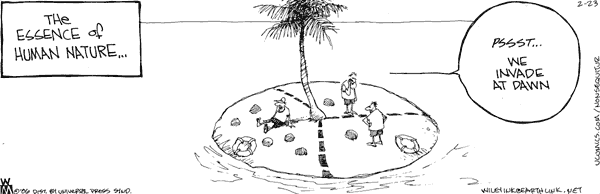
The Dilbert cartoon on the fungibility of oil was great, but when a cartoon can explain all that anyone needs to know about international politics, it's even better!!!!
What To Do In Darfur
Now here I do have some ideas. Following my last post on Darfur, Bush seems to be getting even more serious, and is suggesting that NATO take a more involved role in stopping the bloodshed in Darfur. It's about time. If anything should be done to help Darfur, waiting for the UN to help is absurd. It's time NATO gets involved, telling states that sovereignty is not a blanket protection from punishment for genocide or crimes against humanity. Power used in pursuit of liberal values is power well-used. The failure of the West to prevent the Rwandan genocide is one of the blackest marks on US foreign policy in recent history; let's not let it happen again.
A Papal Smackdown
Normally, I hate when the Vatican gets involved in politics, but today the Pope is right on. The Vatican today has urged Muslim nations upset by the Danish cartoons to practice religious toleration in their own countries. As the Reuters article points out "limits on Christians in some Islamic countries are far harsher than restrictions in the West that Muslims decry, such as France's ban on headscarves in state schools. Saudi Arabia bans all public expression of any non-Muslim religion and sometimes arrests Christians even for worshipping privately. Pakistan allows churches to operate but its Islamic laws effectively deprive Christians of many rights." These are the states that the US media is trying to appease and "understand."
What To Do In Iraq
No, I don't have the answer. But other people may. Alex Tabarrok over at Marginal Revolution informs us of an upcoming CSPAN program entitled Innovative Solutions for Iraq. The program features many smart people, including Lawrence Korb, Lt. Gen William Odem, and Peter Brookes, and will discuss:
The recent elections in Iraq have not resolved the main problems there—a constitutional crisis, continued terrorism, a potent Sunni rebellion, and fighting between religious and ethnic groups that could result in a full-blown civil war. Is the Iraq war a hopeless quagmire that has been lost, or can the U.S. still foster a united, peaceful and prosperous Iraq? If the latter, how can this be achieved? Should the Iraqi constitution be revised and, if so, how? Should the U.S. withdraw its forces—with Iraq partitioned—or use the threat of withdrawal to pressure Iraqi groups into a negotiated settlement? Should the U.S. extract troops rapidly, pull them out gradually, stay the course with current Bush administration policy, or escalate its involvement, as advocated by Senator John McCain? This very timely policy forum will address these thorny issues and propose varied and innovative solutions for Iraq.The forum will be broadcast on CSPAN Saturday, February 25, 9:00 p.m. ET (6:00 p.m. PT) and Monday, February 27, 6:20 a.m. ET (3:20 a.m. PT).
Wednesday, February 22, 2006
Sudan Rejects UN Peacekeepers
Shocking. Sudan has decided to block the UN from deploying peacekeepers into Darfur to protect the people who are being raped and killed by militias sponsored by the central government. There are currently 7,000 peacekeepers from the African Union in Darfur, but they have proven largely ineffective. Additionally, the UN estimates that nearly twice that number are needed to protect the Darfurians (?).
As I have said many times, the UN needs to decide between protecting sovereignty and protecting human rights. It just can't do both.
As I have said many times, the UN needs to decide between protecting sovereignty and protecting human rights. It just can't do both.
Hamas Settles In
Hamas has been asked by Palestinian President Mahmoud Abbas to form the next Palestinian government at the same that Israel has announced it will cease transferring collected tax revenues of about $50 a month to the Palestinians. Interestingly, Israeli Interim Prime Minister Ehud Olmert has chosen this moment to declare that Hamas does not pose a strategic threat to Israel.
I read Olmert's comments are paving the way for Israel to give Hamas some space to decide what kind of government it wants to create. By declaring that Hamas does not threaten the existence of Israel, Olmert is likely preparing Israel for the possibilities of dealing with a Hamas-led Palestinian government. A wise decision, I believe.
However, the decision to withhold the Palestinian tax revenue is unwise and threatens to force Hamas' hand. Hamas has already looked towards Iran to make up for the lost cash flow, and strangling the Palestinian people can only ramp up support for new violent attacks. Israel should resume the payments to the PA immediately, predicating the flow on the continued absence of terrorist attacks against Israel (and of course, threatening wide-scale military responses as well as continued separation). This would give Hamas both the incentive and the time to decide how it wants to deal with Israel. Note there has not been a resumption of suicide attacks, or any other uses of violence, by Hamas or Fatah since the election. Now is not the time for Israel to antagonize the situation. If Hamas is truly not a strategic threat as Olmert claims and I believe, then why not give Hamas the money until it screws up?
I read Olmert's comments are paving the way for Israel to give Hamas some space to decide what kind of government it wants to create. By declaring that Hamas does not threaten the existence of Israel, Olmert is likely preparing Israel for the possibilities of dealing with a Hamas-led Palestinian government. A wise decision, I believe.
However, the decision to withhold the Palestinian tax revenue is unwise and threatens to force Hamas' hand. Hamas has already looked towards Iran to make up for the lost cash flow, and strangling the Palestinian people can only ramp up support for new violent attacks. Israel should resume the payments to the PA immediately, predicating the flow on the continued absence of terrorist attacks against Israel (and of course, threatening wide-scale military responses as well as continued separation). This would give Hamas both the incentive and the time to decide how it wants to deal with Israel. Note there has not been a resumption of suicide attacks, or any other uses of violence, by Hamas or Fatah since the election. Now is not the time for Israel to antagonize the situation. If Hamas is truly not a strategic threat as Olmert claims and I believe, then why not give Hamas the money until it screws up?
Tuesday, February 21, 2006
Update on The Smoking Signature
Kevin Jon Heller over at Opinio Juris has an extremely important update on the trial of Saddam Hussein (damn these time zones...by the time I wake up, all the good stuff has already been blogged about!!). Last week, it looked as if the prosecution was introducing some hard evidence of Hussein's guilt: a memo signed by Saddam himself ordering the execution of 140 Shi'ites. Today, however, it's being reported that the memo is not quite so damning. Rather than an execution order the document shows "Saddam signing off on bonuses for security agents in the investigation of the assassination attempt and presidential approval of death sentences for residents of Dujail, north of Baghdad" and "Saddam's approval of a recommendation allegedly made by Barzan Ibrahim, his half brother and co-defendant, to reward intelligence officers for their "confrontation against subversive and armed elements ... in the Dujail area."
This is an excellent example of why it's going to be so hard to get guilty verdicts in this trial, as well as that of Slobodan Milosevic. As the AP reports, "Saddam's approval of death sentences handed down by the Revolutionary Court against Shiites from Dujail could not prove incriminating unless there is compelling evidence that Saddam knew the defendants were railroaded. Also, orders for arrests or transfers of detainees from one facility to another mean little unless the prosecution can prove that Saddam knew they would be tortured." As the sovereign ruler of Iraq, Hussein had a right and duty to protect his country, even through methods we might find repugnant. To find him guilty, the prosecutors have to show that Hussein knew what was going on and had a hand in ordering murders. It's simple enough for Hussein to claim that he was suppressing a rebellion and that if a few officers went beyond the call of duty and tortured or murdered a few Kurds or Shiites, Hussein had nothing to do with it. In the words of Saddam's attorney, "There is nothing in these documents that show anything beside President Saddam exercising his constitutional authorities. As president, he ratifies death sentences and approves promotions."
The chief prosecutor has announced that he does in fact have hard evidence, claiming "he would present a document during the next session, Feb. 28, involving communication between the intelligence agency and Saddam that he suggested would further tie Saddam directly to the Dujail crackdown." We'll see....
This is an excellent example of why it's going to be so hard to get guilty verdicts in this trial, as well as that of Slobodan Milosevic. As the AP reports, "Saddam's approval of death sentences handed down by the Revolutionary Court against Shiites from Dujail could not prove incriminating unless there is compelling evidence that Saddam knew the defendants were railroaded. Also, orders for arrests or transfers of detainees from one facility to another mean little unless the prosecution can prove that Saddam knew they would be tortured." As the sovereign ruler of Iraq, Hussein had a right and duty to protect his country, even through methods we might find repugnant. To find him guilty, the prosecutors have to show that Hussein knew what was going on and had a hand in ordering murders. It's simple enough for Hussein to claim that he was suppressing a rebellion and that if a few officers went beyond the call of duty and tortured or murdered a few Kurds or Shiites, Hussein had nothing to do with it. In the words of Saddam's attorney, "There is nothing in these documents that show anything beside President Saddam exercising his constitutional authorities. As president, he ratifies death sentences and approves promotions."
The chief prosecutor has announced that he does in fact have hard evidence, claiming "he would present a document during the next session, Feb. 28, involving communication between the intelligence agency and Saddam that he suggested would further tie Saddam directly to the Dujail crackdown." We'll see....
Monday, February 20, 2006
More on China and Google
Sunday's Washington Post had an excellent article about China and the censoring of the Internet. In short, the article argues that "widespread Internet use in [China's] largest cities and among the educated is changing the way Chinese learn about the world and weakening the Communist Party's monopoloy on the media." How is this possible? Doesn't the Chinese government censor the Internet? Doesn't Google help the Communist Party do this, in a nefarious attempt to make money at all costs?
The article writes that "the success of those [censorship] measures has been mixed. ...the Internet presents a formidable challenge to China's authoritarian political system." Just having access to the Internet, even if it's under governmental control, makes it more difficult to keep information out. And the more information flows into China, the better. So, as I've said before, chastising, punishing, or preventing Google from bringing the Internet into China, even if they have to collaborate with the Communist Party to do so, is extremely short-sighted.
The article writes that "the success of those [censorship] measures has been mixed. ...the Internet presents a formidable challenge to China's authoritarian political system." Just having access to the Internet, even if it's under governmental control, makes it more difficult to keep information out. And the more information flows into China, the better. So, as I've said before, chastising, punishing, or preventing Google from bringing the Internet into China, even if they have to collaborate with the Communist Party to do so, is extremely short-sighted.
Saturday, February 18, 2006
Subscribe to:
Posts (Atom)


 Posts
Posts